LoadMaster Exploitation Puts The Traffic Edge In Incident Scope
CISA added LoadMaster CVE-2026-8037 to KEV after exploitation reports. Operators must patch the API flaw and examine the appliance as an incident boundary.
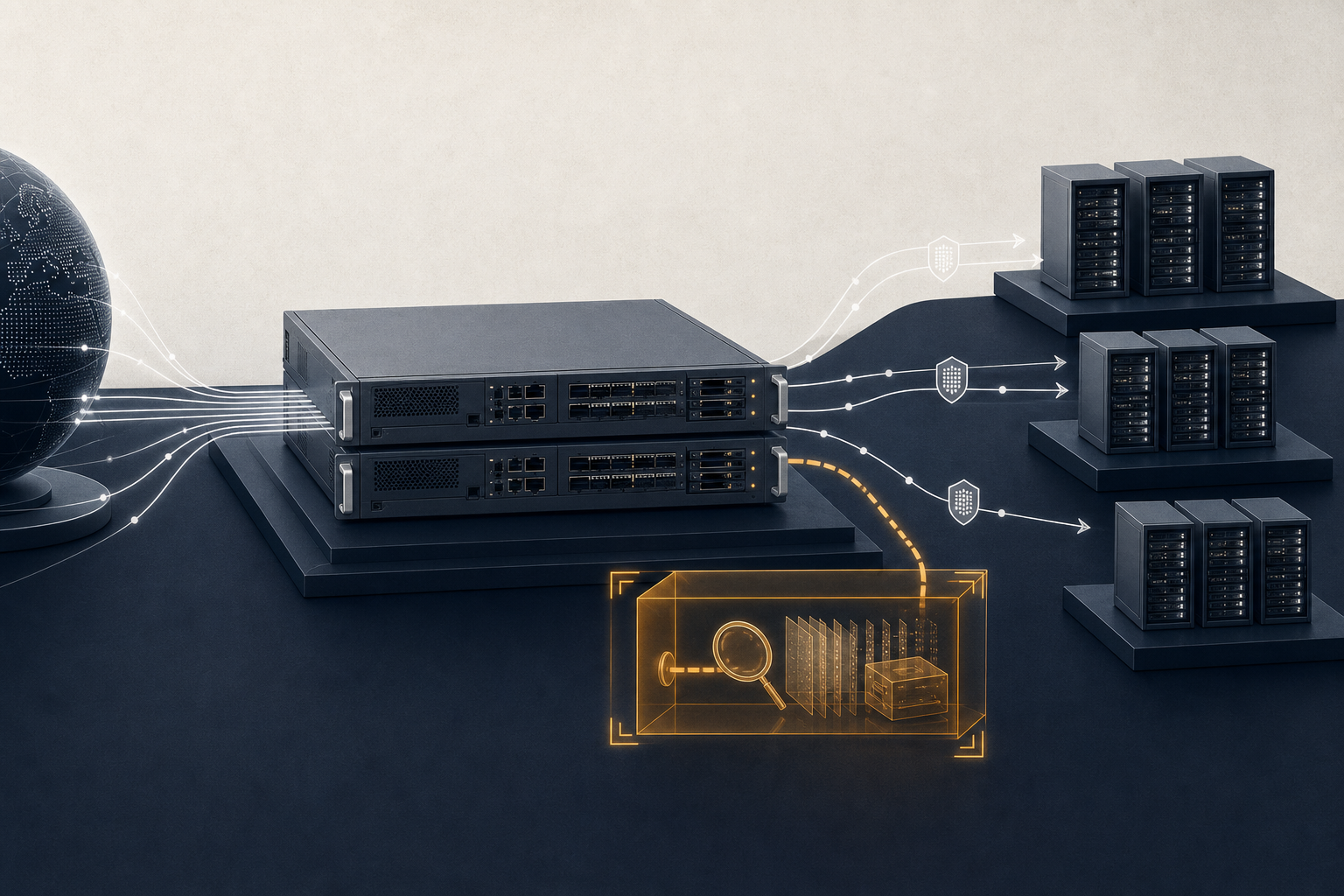
CISA added CVE-2026-8037 to its Known Exploited Vulnerabilities catalog on August 7 after earlier reports of exploitation attempts against Progress Kemp LoadMaster. The flaw lets an unauthenticated attacker who can reach an enabled API execute operating system commands on a vulnerable appliance. Progress published fixes in June, but the KEV listing turns any still-exposed system into urgent patch and incident-response work rather than an ordinary maintenance item.
LoadMaster often sits between untrusted traffic and important internal applications. That position can give the appliance knowledge of virtual services, backend addresses, routing rules, administrative accounts, certificates, and other security-sensitive configuration. Successful code execution does not prove that every one of those assets was accessed, but it makes the integrity of the appliance and the trust placed in its traffic handling legitimate investigation questions. Teams should preserve evidence, patch every node, look for appliance-level changes and unexpected outbound activity, and reassess credentials or key material according to what the device could expose.
Key Takeaways
- check_circle CVE-2026-8037 is a confirmed exploitation priority: CISA added it to KEV on August 7, 2026.
- check_circle The vulnerable path is unauthenticated when the LoadMaster API is enabled and reachable; a valid administrator login is not required.
- check_circle Fixed releases are LoadMaster GA 7.2.63.2 and LoadMaster LTFS 7.2.54.18, with the same 7.2.63.2 boundary for affected Connection Manager products.
- check_circle Patching stops the known entry path but does not establish that an appliance was never accessed or that its configuration remains trustworthy.
- check_circle Investigation should cover API requests, appliance processes, configuration changes, new accounts or keys, persistence, outbound connections, and backend access.
- check_circle Public sources do not identify an actor, victim count, complete payload set, or ransomware connection, so response decisions should not depend on those unknowns.
The June Fix Became An August Exploitation Deadline
Progress disclosed CVE-2026-8037 in a June 4 security bulletin. The affected version boundaries are LoadMaster GA 7.2.63.1 and earlier and LoadMaster LTFS 7.2.54.17 and earlier. CERT-FR also lists Connection Manager for ObjectScale and ECS Connection Manager releases before 7.2.63.2. Operators should use the Progress bulletin for the exact package that matches their deployment, then verify the version on the running appliance rather than treating a downloaded update as proof of installation.
The exploitation timeline developed after the fix was available. eSentire says its Threat Response Unit observed exploitation attempts beginning June 29, the same day functional proof-of-concept research became public. Canada's Cyber Centre later updated its advisory to say open-source reporting indicated exploitation in the wild. On August 7, CISA added CVE-2026-8037 to KEV and set an August 10 remediation date for covered federal systems.
A KEV entry confirms that exploitation has occurred, but it does not say that every internet-facing LoadMaster was compromised. It also does not identify the attacker, the number or identity of victims, the commands executed, or whether a particular organization's traffic was observed. Those distinctions matter. Exposure establishes priority; local evidence establishes incident scope.
The API Converts A Memory Error Into Command Execution
The NVD description classifies CVE-2026-8037 as operating system command injection in the API and says unsanitized input reaches multiple command endpoints. The vendor assessment scores it 9.6. An attacker does not need an account, but the API must be enabled and reachable from the attacker's network position. An appliance that has the API restricted to a tightly controlled management segment has a different exposure profile from one that accepts API traffic from the internet.
Independent analysis from watchTowr examined the change between vulnerable 7.2.63.1 and fixed 7.2.63.2 builds. The researchers traced the exploit to incorrect handling of an allocated string buffer, which could leave attacker-influenced content in memory without proper termination. Their proof of concept used heap manipulation to make that content reach a shell command. eSentire separately described the vulnerable access through the /accessv2 endpoint when the API is enabled.
Defenders do not need to reproduce that heap behavior to act. The operational facts are simpler: unauthenticated network input can become a command under the appliance's operating context, and public exploit details have been available since late June. Authentication failures therefore are not a reliable prerequisite for detection. API visibility, process activity, and configuration integrity matter more than a search limited to failed logins.
An Edge Appliance Holds More Than An IP Address
A LoadMaster is intended to accept client connections and distribute them to backend services. Depending on configuration, it may also terminate TLS, enforce web application firewall policy, check backend health, rewrite requests, and select routes using application-layer data. This makes it a control point for availability and traffic policy, not merely another server with a management page.
If an attacker executes commands on that control point, the plausible scope follows the appliance's real privileges. Investigators should inventory virtual services, backend targets, administrative and API identities, locally stored certificates, private keys, authentication integrations, exported backups, logging destinations, and network routes. Inclusion in scope is not a claim that each item was stolen. It is a disciplined way to determine what a compromised appliance could read, change, or use.
The appliance can also become a route inward. Management networks, monitoring systems, directory services, configuration repositories, and backend applications may trust connections from its addresses. Review those systems for activity tied to the LoadMaster during the exposure window. A clean public-facing access log cannot rule out later movement initiated from the appliance itself.
Patch Every Node And Preserve The Evidence You Need
The fixed version boundary is explicit: update GA systems to 7.2.63.2 or later and LTFS systems to 7.2.54.18 or later. Connection Manager for ObjectScale and ECS Connection Manager should reach 7.2.63.2 or later. High-availability pairs, disaster-recovery appliances, lab clones, and powered-down standby images all belong in the inventory. A patched active node does not compensate for an old failover peer that can later return to service.
Where suspicious activity exists, preserve relevant logs, configuration exports, timestamps, network telemetry, and volatile observations before an upgrade or reboot changes them. Evidence collection must still respect service availability and the possibility that the host is hostile. If the management API cannot be patched immediately, restrict it to known administration paths and remove public reachability, but treat that restriction as temporary exposure reduction rather than a replacement for the vendor fix.
After deployment, verify the running version on each node, confirm API and management access controls, and test the intended traffic path. Record the time each node crossed the fixed boundary. That timestamp separates requests that could have reached vulnerable code from later requests that should have been blocked, which makes subsequent triage substantially more reliable.
Hunt For Appliance Changes Without Inventing Indicators
Start with HTTP and API telemetry for unexpected access to management endpoints, including /accessv2, and correlate it with reverse-proxy, firewall, load balancer, and network-flow records. Look for unusual source addresses, repeated crafted requests, response-size or status anomalies, and activity outside administrative windows. An exploit can be unauthenticated, so the absence of a corresponding user session is not reassuring.
On the appliance, examine unexpected processes, shell or command execution, new or modified files, startup behavior, scheduled activity, account and key changes, altered virtual services, WAF policy changes, logging disruption, and outbound connections not explained by normal integrations. Compare the current configuration with a known-good export, but account for approved operational changes so the investigation does not collapse into an unaudited diff.
Public reporting does not provide a complete, durable set of campaign indicators. eSentire says it blocked known malicious addresses for its customers, but its advisory does not publish a universal list. Defenders should not substitute a short IP search for behavior and integrity review. Attack infrastructure changes quickly, and another operator may use the same vulnerability with different payloads.
Recovery Depends On What The Appliance Could Reach
If evidence supports successful command execution, isolate the affected node through a path that does not depend on its own enforcement. Rebuild from trusted media or follow Progress support guidance when appliance integrity cannot be established. Reintroducing a configuration backup is not automatically safe; examine it for unauthorized accounts, keys, routes, services, policy changes, and persistence before import.
Rotate credentials and key material according to exposure, not by reflexive checklist. Administrative passwords, API tokens, service credentials, and private keys available to the appliance deserve priority. If TLS private-key access cannot be ruled out, certificate replacement may be necessary. Coordinate with application owners before changing backend secrets or certificates so that emergency rotation does not cause an avoidable outage or erase evidence.
Continue monitoring after recovery for connections from the appliance's former addresses, unusual backend authentication, changed client behavior, and attempts against the patched API. Document what remains unknown. As of August 11, the public record confirms exploitation but does not provide a complete campaign map, named actor, victim total, or known ransomware use. That uncertainty supports careful scoping, not unsupported attribution.
Checklist
- Inventory every LoadMaster, failover node, recovery image, and affected Connection Manager deployment.
- Verify GA is 7.2.63.2 or later and LTFS is 7.2.54.18 or later on the running systems.
- Restrict API and management reachability to documented administration paths.
- Preserve API, appliance, proxy, firewall, flow, and configuration evidence for the exposure window.
- Review processes, files, accounts, keys, persistence, policy changes, and unexpected outbound traffic.
- Trace access from appliance addresses into management systems and backend applications.
- Rebuild or rotate credentials and key material when integrity or exposure cannot be established.
Sources
- Progress LoadMaster Critical Security Bulletin, June 2026 open_in_new
- CISA Known Exploited Vulnerabilities catalog feed open_in_new
- NVD record for CVE-2026-8037 open_in_new
- Canadian Centre for Cyber Security Progress advisory AV26-552 open_in_new
- CERT-FR advisory CERTFR-2026-AVI-0883 open_in_new
- eSentire advisory on observed LoadMaster exploitation attempts open_in_new
- watchTowr technical analysis of CVE-2026-8037 open_in_new
Continue Reading
Windows AFD Exploitation Turns Local Access Into SYSTEM Risk
Microsoft and CISA confirm exploitation of Windows AFD CVE-2026-68820. Patch affected systems and scope local access that could have become SYSTEM.

Teams August Fixes Split Cloud Assurance From Mobile Patching
Microsoft disclosed three mitigated Teams cloud flaws and an Android file-based RCE. Cloud users have no patch, but mobile fleets need version proof.
TeamCity Exploitation Puts Build Trust Under Review
JetBrains reports active exploitation of TeamCity CVE-2026-63077. Patching the server is urgent, but CI credentials, agents, and artifacts also need scoping.