Cisco Unified CM WebDialer SSRF Needs Fast Triage
Cisco disclosed CVE-2026-20230, an unauthenticated WebDialer SSRF flaw in Unified Communications Manager that can lead to file write and later root escalation when WebDialer is enabled. Patch planning and service exposure checks should start now.
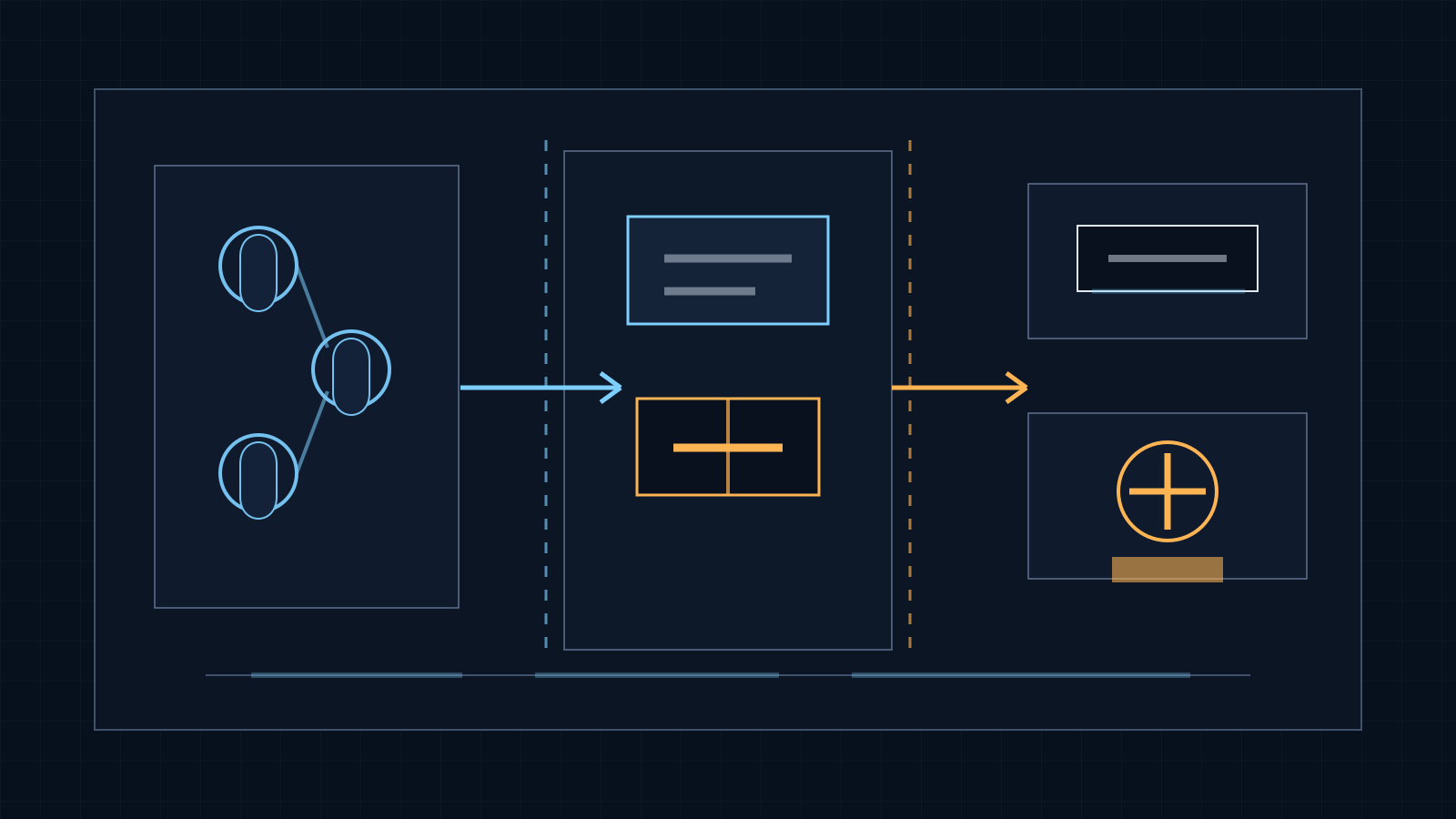
Cisco published a June 3, 2026 advisory for CVE-2026-20230, a server-side request forgery vulnerability in Cisco Unified Communications Manager and Unified Communications Manager Session Management Edition. Cisco gives the CVSS v3.1 score as 8.6 but assigns a Critical Security Impact Rating because exploitation could let an attacker write files to the underlying operating system and later elevate privileges to root.
The most important deployment condition is WebDialer. Cisco says the vulnerability affects Unified CM and Unified CM SME only if the Cisco WebDialer Web Service is enabled, and Cisco says WebDialer is disabled by default. That condition should not slow triage. Cisco also says proof-of-concept exploit code is available, there are no workarounds that fully address the vulnerability, and disabling WebDialer is only a mitigation until a fixed release or patch is applied.
Key Takeaways
- check_circle CVE-2026-20230 is unauthenticated and remote, but it requires the WebDialer service to be enabled.
- check_circle Cisco marked the advisory Critical because the SSRF path can support file write and later root escalation.
- check_circle Cisco says proof-of-concept exploit code is public, while it was not aware of malicious use when the advisory was published.
- check_circle Fixed release planning differs by branch: Release 14 has 14SU6, while Release 15 needs 15SU5 or a version-specific COP patch.
- check_circle Disabling WebDialer can reduce exposure, but Cisco treats patching as the full remediation.
What Cisco Confirmed
Cisco's advisory describes an unauthenticated, remote SSRF vulnerability caused by improper input validation for specific HTTP requests. An attacker could send a crafted request to an affected device. A successful exploit could write files to the underlying operating system, and those files could later be used to elevate privileges to root. NVD mirrors the core impact and records CVE-2026-20230 as a Cisco-sourced SSRF issue with CWE-918.
The affected products are Cisco Unified CM and Cisco Unified CM SME when WebDialer is enabled. Cisco's public advisory names no vulnerable products beyond that section. Cisco also states that its Product Security Incident Response Team is aware of proof-of-concept exploit code, but was not aware of malicious use of the vulnerability described in the advisory at publication time. Those facts should be kept separate: public exploit code raises urgency, but public exploit code is not the same thing as confirmed exploitation.
Why WebDialer Is The Pivot
WebDialer exists to support click-to-dial workflows. Cisco's developer documentation describes it as a Unified CM service that provides a click-to-dial API for web-service and browser-based applications. It exposes SOAP and HTML interfaces through the Unified CM node that runs the service. That makes it useful for corporate directories, desktop applications, and user workflows that initiate calls from a web page or integrated application.
The same placement makes it security-sensitive. WebDialer sits between HTTP-facing requests and call-control infrastructure. In a normal deployment, that boundary should authenticate callers, validate inputs, and avoid turning user-controllable request data into server-side actions. Cisco's advisory says the vulnerable path is specific HTTP request input validation. If the service is enabled where it does not need to be, the organization has unnecessary exposure to a flaw that can move beyond application behavior into operating-system file write.
Patch Status And Mitigation
Cisco states there are no workarounds that address the vulnerability. The fixed software table lists Cisco Unified CM and Unified CM SME Release 14 fixed in 14SU6. For Release 15, Cisco lists 15SU5, expected in September 2026, or a version-specific COP patch. Cisco also notes that patches are version-specific and that customers should consult the README attached to the patch.
Cisco does provide a mitigation: disable the Cisco WebDialer Web Service until a patch can be applied. The advisory gives the administration path for checking whether WebDialer is started and for disabling it through Cisco Unified Serviceability. That mitigation can have functional impact because it removes click-to-dial behavior for workflows that depend on WebDialer. The operational decision is therefore not simply security versus convenience. It is whether the service is business-critical enough to keep enabled during an exploit-code window before the right fixed release is installed.
How To Triage Deployments
Start by finding every Unified CM and Unified CM SME cluster, including lab, disaster-recovery, acquired-company, and partner-managed environments. Voice platforms often sit outside the patch cadence used for ordinary servers because they involve call routing, maintenance windows, phone firmware, carrier dependencies, and change-approval boards. That makes inventory discipline especially important when a public proof of concept exists.
For each cluster, record the release, service status, exposure path, and business owner. Cisco's advisory says administrators can check WebDialer status under Cisco Unified Serviceability, Control Center - Feature Services, in the CTI Services section. If the service status is Started, treat the system as affected until version and patch state prove otherwise. Then decide whether to disable WebDialer immediately, patch immediately, or use a brief compensating-control window for clusters whose call workflows cannot tolerate abrupt service removal.
Exposure Is Not Only Internet Exposure
The obvious risk is an internet-reachable Unified CM interface with WebDialer enabled. That should be rare in a well-run environment. The more common risk is internal reachability from user networks, VPN clients, VDI environments, jump hosts, partner networks, or compromised workstations. Unauthenticated internal attack paths matter because collaboration infrastructure often has privileged relationships with phones, directories, call managers, recording systems, contact centers, and administrative networks.
Network controls should narrow who can reach WebDialer and Unified CM management surfaces while the patch is being scheduled. Restrict access to trusted administrative and application subnets, review reverse proxies and load balancers, and check whether any click-to-dial integrations expose WebDialer through user-facing portals. If WebDialer is not required, disable it. If it is required, isolate it to the smallest practical set of callers and watch logs for crafted or unusual requests.
Detection And Response
Cisco's advisory does not publish indicators of compromise for this flaw. That means defenders should work from behavior. Review web access logs, application logs, file integrity signals, and service restarts around WebDialer endpoints. Look for unusual requests to WebDialer paths, unexpected writes under application or operating-system directories, abnormal service-user activity, and post-request changes that do not match maintenance windows.
If suspicious activity appears, preserve logs before changing the system, isolate the affected node where feasible, and involve Cisco TAC or an incident-response team familiar with Unified CM. Because Cisco describes a path to file write and later root escalation, a simple service restart is not enough if exploitation is suspected. The response should include filesystem review, account and key review, patching or rebuild decisions, and verification that call-control trust relationships were not abused after initial access.
The Collaboration Infrastructure Lesson
Unified communications platforms are not just phone systems anymore. They are identity-connected, web-administered, API-driven collaboration infrastructure. They integrate with directories, contact centers, recording platforms, emergency-calling systems, softphones, desk phones, and sometimes customer-facing workflows. That creates a larger security boundary than many organizations acknowledge during normal patch cycles.
The durable lesson from CVE-2026-20230 is service minimization. Optional collaboration services should be disabled unless a current workflow requires them. When a service is enabled, the owner should know why, where it is reachable, who depends on it, and how quickly it can be turned off. Public proof-of-concept code compresses the time available for that decision. For this advisory, the practical answer is to patch fixed branches, disable WebDialer where unused, and treat enabled WebDialer as an urgent exposure until proven otherwise.
Checklist
- Inventory every Cisco Unified CM and Unified CM SME cluster, including nonproduction and partner-managed systems.
- Check whether Cisco WebDialer Web Service is Started under Cisco Unified Serviceability.
- Upgrade Release 14 deployments to 14SU6 and apply the appropriate Release 15 fixed release or COP patch when applicable.
- Disable WebDialer where click-to-dial workflows do not require it, especially before patching.
- Restrict network paths to Unified CM and WebDialer surfaces during the remediation window.
- Review WebDialer logs, file-write activity, service restarts, and unexpected privileged changes if exposure existed.
Sources
- Cisco: Unified Communications Manager SSRF advisory CVE-2026-20230 open_in_new
- NVD: CVE-2026-20230 open_in_new
- Cisco DevNet: WebDialer Developer Guide open_in_new
- Cisco Unified Serviceability Administration Guide, Release 12.0(1) open_in_new
- Cisco Feature Configuration Guide: WebDialer, Release 15 and SUs open_in_new
- Cyber Security Agency of Singapore: Critical Vulnerability in Cisco Unified Communications Manager open_in_new
- Canadian Centre for Cyber Security: Cisco security advisory AV26-547 open_in_new
Continue Reading
HP Poly VoIP Flaw Turns Phones Into Root Targets
HP and Rapid7 disclosed CVE-2026-0826, a critical unauthenticated stack buffer overflow in Poly VVX and Trio VoIP phones when ICE is enabled. Voice devices need the same exposure scoping, firmware control, and segmentation discipline as other Linux endpoints.
Microsoft 365 Android Token Flaw Moves Risk To Mobile
Enclave disclosed a patched Microsoft 365 Android token flaw that let an untrusted local app request account tokens from signed-in Office apps. The practical work is mobile patch verification, refresh-token response, and tighter release gates around shared identity SDKs.

Opus 4.8 Helped Find Zcash's Orchard Forgery Bug
Taylor Hornby found a critical Zcash Orchard soundness bug using Opus 4.8 and custom tooling. The fix is live, but the incident turns supply proofs, shielded-pool accounting, and AI-assisted audits into practical security questions.