HP Poly VoIP Flaw Turns Phones Into Root Targets
HP and Rapid7 disclosed CVE-2026-0826, a critical unauthenticated stack buffer overflow in Poly VVX and Trio VoIP phones when ICE is enabled. Voice devices need the same exposure scoping, firmware control, and segmentation discipline as other Linux endpoints.
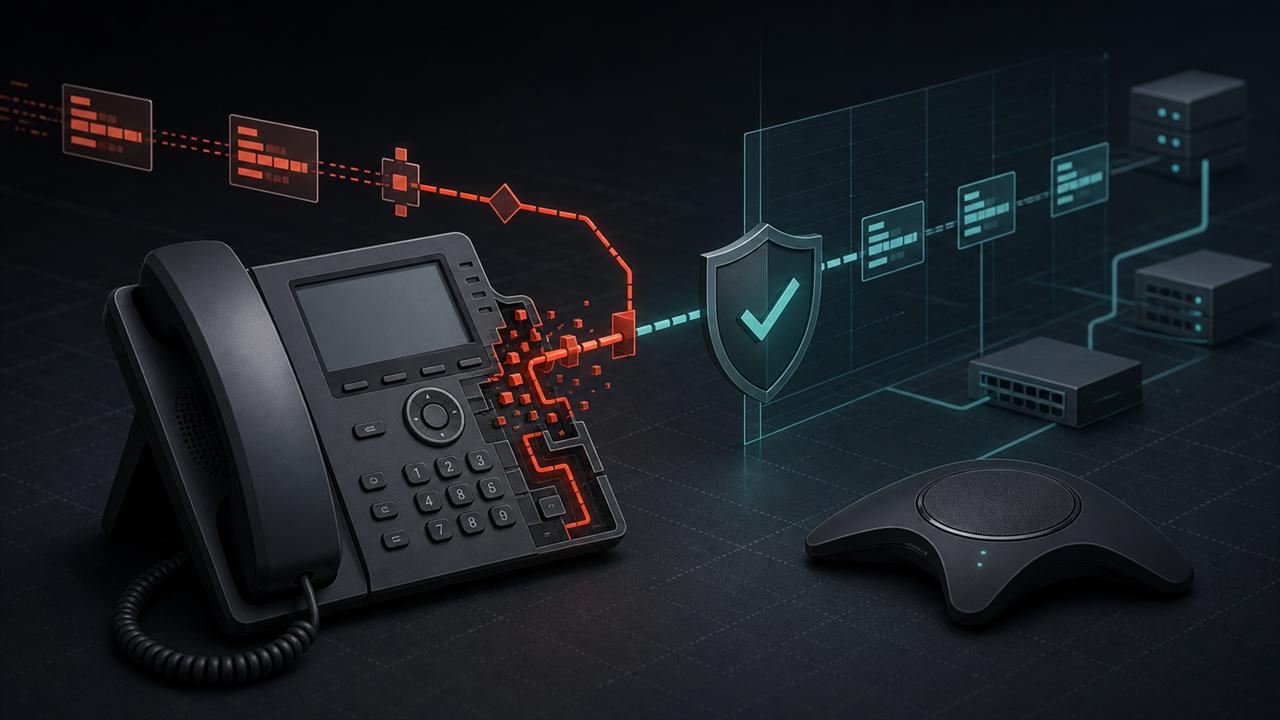
HP published a June 1, 2026 security bulletin for CVE-2026-0826, a critical remote code execution issue in certain Poly Voice products on Linux when an administrator has enabled Interactive Connectivity Establishment, or ICE. HP lists a CVSS 4.0 base score of 9.2 and recommends disabling ICE when it is not required and updating affected devices to the latest UCS release.
Rapid7's disclosure fills in the technical risk. The researcher found an unauthenticated stack-based buffer overflow in parsing Session Description Protocol candidate attributes used by ICE. Rapid7 validated the issue on a Poly VVX 450 and says HP confirmed affected VVX and Trio models. The practical lesson is broader than one phone line: enterprise voice hardware is software infrastructure and should be inventoried, segmented, patched, and monitored like any other networked Linux device.
Key Takeaways
- check_circle CVE-2026-0826 requires ICE to be enabled, and Rapid7 says ICE is not enabled by default.
- check_circle The affected product families include Poly VVX 150, 250, 350, and 450 phones and Poly Trio 8300, 8500, and 8800 conference devices.
- check_circle Rapid7 says exploitation can produce unauthenticated remote code execution with root privileges on a vulnerable device.
- check_circle HP's mitigation is to disable ICE where it is not required and update affected devices to current UCS firmware.
- check_circle Voice VLANs should not be treated as trusted side networks just because the endpoints look like phones.
What HP And Rapid7 Disclosed
HP's bulletin describes a critical flaw in Poly Voice devices where a buffer overflow could enable remote code execution in certain scenarios when ICE has been enabled by an administrator. The bulletin identifies the issue as CVE-2026-0826, lists the security impact as remote code execution, and gives a CVSS 4.0 score of 9.2. HP credits Stephen Fewer of Rapid7 and tells administrators to disable ICE when it is not required and update affected Poly Voice devices to the latest UCS release.
Rapid7's technical writeup says the vulnerability is present in parsing SDP attributes for ICE. During a SIP request, a candidate attribute can be parsed when ICE is enabled. Rapid7 says the vulnerable code copies an incoming candidate string into a 256-byte stack buffer without a sufficient destination length check. That bug class is old, but the context is modern: a network-exposed collaboration device parsing call setup data.
The ICE Condition Matters
The strongest limiting condition is ICE. Rapid7 states that ICE is not enabled by default, and HP frames the affected scenario around administrators who enabled ICE. That matters for triage because not every installed phone is necessarily exploitable from the same network position. The first task is not panic replacement. It is inventory: which VVX and Trio devices exist, what firmware they run, and whether ICE is enabled in the configuration pushed to each device.
ICE is used to help media sessions find working connectivity paths across NAT and network boundaries. In normal terms, it is there to make voice and video sessions work through complicated network paths. In security terms, enabling optional protocol parsing widens the inputs a device has to process. If a site does not need ICE for its calling architecture, disabling it is a meaningful exposure reduction while firmware updates are planned.
Why Root On A Phone Is Still Root
VoIP devices are often treated as appliances rather than computers. That habit creates risk. A phone may sit on a dedicated voice VLAN, receive DHCP options and provisioning files, authenticate to call-control infrastructure, keep local configuration, process SIP traffic, and expose management surfaces. If an attacker obtains root on the device, the immediate impact is not limited to whether someone can make a call.
A compromised phone can become a network foothold, a packet vantage point, a persistence point, or a staging device for attacks against call infrastructure. The exact blast radius depends on segmentation, management reachability, credentials, logging, and whether the voice network can reach broader enterprise systems. The device shape is misleading. The operating model should be the same as any other managed endpoint with privileged network position.
Exploitability And Exposure Boundaries
Rapid7 says it developed a Metasploit module to demonstrate unauthenticated remote code execution with root privileges against a vulnerable VVX 450. That does not prove mass exploitation, and the public sources reviewed here do not show confirmed in-the-wild use of CVE-2026-0826. It does mean defenders should treat exploitability as practical, not theoretical, especially where vulnerable phones can receive SIP traffic from untrusted or loosely filtered network sources.
Exposure scoping should answer where SIP reaches the device, who can send UDP traffic to port 5060, which call-control systems are allowed, whether phones can talk directly to each other across sites, and whether guest, VPN, wireless, or office networks can reach the voice VLAN. A phone behind a strict call-control boundary is a different risk than a phone reachable from many internal segments or from partner networks.
How To Patch And Contain
Start by exporting device inventory from HP Poly Lens, call-control systems, DHCP reservations, NAC, network scans, and configuration management. Do not assume old conference rooms, labs, executive offices, branch closets, or spare-device shelves are covered by the primary voice inventory. Then identify VVX 150, VVX 250, VVX 350, VVX 450, Trio 8300, Trio 8500, and Trio 8800 devices and map each to firmware, ICE status, network segment, and business owner.
For containment, disable ICE where it is unnecessary, restrict SIP and management access to expected call-control and management systems, block lateral reachability from ordinary user networks to voice endpoints, and schedule firmware updates. Where emergency patching is not possible, place high-risk devices behind tighter ACLs and monitor for unexpected SIP sources, restarts, process crashes, or management changes. Firmware work should include rollback planning because voice devices sit in operational workflows, but delay should be justified by actual service risk.
What Remains Unknown
The public advisories do not show widespread exploitation, complete customer exposure numbers, or every possible deployment path that could make ICE reachable. HP's bulletin gives the vendor remediation direction, while Rapid7 gives the technical exploitability analysis. The operational gap sits between them: each organization has to determine whether its voice architecture makes the vulnerable parsing path reachable.
The durable lesson is that collaboration hardware needs security ownership. Phones and conference devices are part of the communications stack that supports executive calls, legal conversations, incident rooms, support desks, and customer operations. They should have asset owners, patch windows, configuration baselines, network controls, and retirement plans. A device that cannot be patched or isolated should not keep privileged network placement because replacing it is inconvenient.
Checklist
- Inventory VVX and Trio devices, including conference rooms, branches, labs, spares, and executive offices.
- Confirm whether ICE is enabled in deployed phone configurations and disable it where unnecessary.
- Update affected devices to HP's current UCS firmware for the relevant model.
- Restrict SIP and management traffic to expected call-control and management systems.
- Review whether user, guest, VPN, wireless, or partner networks can reach voice endpoints.
- Monitor vulnerable fleets for unexpected SIP sources, crashes, reboots, configuration changes, and new outbound traffic.
- Retire or isolate voice hardware that cannot be patched within an acceptable window.
Sources
- HP: Poly Voice possible remote control of certain Poly devices open_in_new
- Rapid7: CVE-2026-0826 critical unauthenticated stack buffer overflow open_in_new
- Rapid7: CVE-2026-0826 and AI-powered impersonation risk open_in_new
- OpenCVE: CVE-2026-0826 record open_in_new
- Rapid7 Vulnerability Database: HP Poly CVE-2026-0826 open_in_new
- IETF RFC 8839: Session Description Protocol attributes for ICE open_in_new
Continue Reading
Instagram Reset Bug Was Patched, But Recovery Data Still Matters
Meta says a password-reset issue was fixed after reports around exposed Instagram contact data. The response is not panic; it is recovery-flow minimization, account review, and tighter masking.
Silent Ransom Group Turns IT Support Into The Breach Path
The FBI and Google warn that Silent Ransom Group is using fake IT support calls, remote access tools, and in-person office visits to steal data from law firms and professional services organizations. The response has to cover help desk identity, visitor controls, RMM policy, and removable media.
Microsoft 365 Android Token Flaw Moves Risk To Mobile
Enclave disclosed a patched Microsoft 365 Android token flaw that let an untrusted local app request account tokens from signed-in Office apps. The practical work is mobile patch verification, refresh-token response, and tighter release gates around shared identity SDKs.