Signal vs. WhatsApp: Privacy Beyond Message Encryption
Signal and WhatsApp both protect personal chats with end-to-end encryption. The larger privacy differences sit in metadata, discovery, backups, linked devices, and business services.
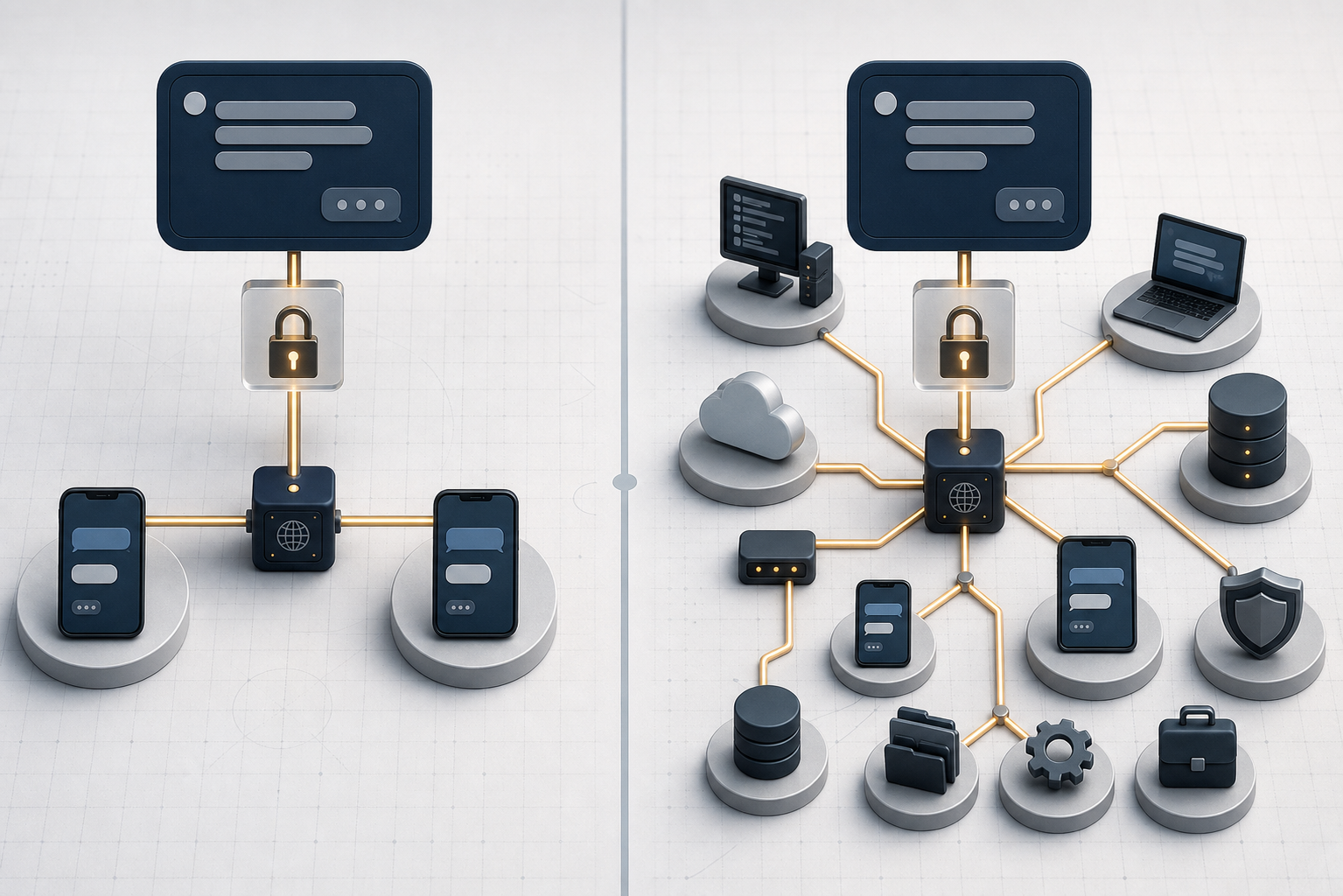
Signal and WhatsApp both provide end-to-end encryption for personal messages and calls, so the useful comparison starts outside the ciphertext. Signal is designed around collecting and retaining as little service data as possible. WhatsApp operates a much larger consumer and business ecosystem and its privacy policy describes broader usage, device, connection, group, interaction, and Meta-company data practices.
Neither service makes an unsafe device, a deceptive contact, or a careless backup harmless. Signal is the stronger default when minimizing provider-held data and avoiding business-platform boundaries matter most. WhatsApp can be the practical choice when reach, existing groups, business contact, and broad device support outweigh that larger data surface. Users should decide per conversation, enable encrypted backups deliberately, review linked devices, and verify sensitive contacts through a separate channel.
Key Takeaways
- check_circle Do not use the encryption badge as the entire privacy comparison; both services encrypt personal content, while their surrounding data practices differ.
- check_circle Both services still require a phone number for registration, even as usernames reduce the need to disclose it to new contacts.
- check_circle Signal's official policy describes a deliberately small server-side data set; WhatsApp's policy lists more usage, connection, group, and interaction data.
- check_circle WhatsApp business conversations can involve the business and its service providers, which creates a different boundary from a personal encrypted chat.
- check_circle Backups and linked devices are separate copies of conversation history and must be reviewed rather than assumed to inherit every chat setting.
- check_circle For highly sensitive conversations, verify identity, minimize devices, protect recovery material, and keep secrets out of support or business workflows.
Registration And Discovery Are Changing
Both services require a phone number to register an account. Signal's usernames already let people initiate contact without sharing that number. By default, a number is not displayed in profile details to people who do not already have it saved, and users can prevent discovery by number. Signal usernames are not public social handles or part of a searchable directory; a person needs the exact username, link, or QR code.
WhatsApp announced username reservations on June 29, 2026 and says the contact feature will launch gradually later in the year. Its planned design also avoids a browsable directory and suggestions. Users will need an exact username, and an optional username key can further restrict first contact. Reserving a name is not the same as having the finished contact-privacy behavior in every region today.
These features reduce disclosure to new classmates, customers, community members, or event contacts, but they do not make the underlying account anonymous. Phone registration remains, existing contacts may already know the number, and a person can correlate identities through shared groups, profile details, reused names, or out-of-band context. Use usernames to limit unnecessary disclosure, not to promise unlinkability.
Metadata Is The Largest Platform Difference
Signal says it stores a phone number for registration, queues encrypted messages for temporarily offline devices, and retains limited technical material needed to establish calls and deliver messages. Its policy says message history stays on user devices, while its government-request page states that it aims to possess as close to no user data as possible. Signal is explicit that it does not sell, rent, or monetize personal data or content.
WhatsApp's policy describes a broader operational data set. It lists usage and log information, feature and settings use, interaction timing and duration, group names and descriptions, online and last-seen state, device and connection information, IP address, identifiers, and approximate location derived from network information. Privacy settings can limit what other users see, but they do not erase every service-side record named in the policy.
This does not mean WhatsApp reads the content of personal encrypted chats. Content confidentiality and metadata minimization are separate properties. A person whose main requirement is hiding message text from network intermediaries can benefit from either service. A person whose risk includes association, activity patterns, account linkage, or provider-held operational records has a stronger reason to prefer Signal's smaller data model.
Business Chats Create Another Boundary
WhatsApp is both a personal messenger and a business communications platform. Its privacy policy warns that content shared with a business may be visible to several people in that organization. A business may also use third-party providers, including Meta, to send, store, read, manage, or otherwise process customer communications. The business's own privacy policy and systems then matter alongside WhatsApp's transport protection.
That distinction is easy to miss because a business conversation lives in the same app as family chats. Do not send identity documents, wallet recovery material, passwords, medical records, or sensitive support attachments merely because the chat shows encryption. Ask what system receives the conversation, who can access it, how long it is retained, and whether the business offers a purpose-built secure upload channel.
Signal has no comparable mass-market business messaging and advertising ecosystem, which reduces this particular platform boundary but also removes features some users need. Organizations choosing Signal still need governance for employee devices, exports, support requests, disappearing-message expectations, and records obligations. A smaller platform surface does not substitute for an organizational policy.
Backups And Linked Devices Need Separate Decisions
Signal Secure Backups are optional and end-to-end encrypted. Signal's current support material says the recovery key is required to restore the archive and is not available to Signal. Users can also transfer history directly between devices in supported scenarios. The privacy benefit comes with a recovery obligation: if the user loses the key and every usable device copy, the provider cannot recover the archive.
WhatsApp also offers optional end-to-end encrypted backups. Its 2025 update added passkey-based protection as an alternative to remembering a backup password or managing a 64-digit key. Users should open the backup settings and confirm the end-to-end encrypted option rather than assuming protection of live chats automatically covers every iCloud or Google storage configuration. Recovery convenience and provider access are design choices, not invisible details.
Linked computers and tablets expand both services beyond the primary phone. Each linked device becomes another place where messages can be decrypted, displayed, cached, notified, or exported. Review the device list regularly, remove hardware that is lost or no longer used, apply operating-system and app updates, and use a screen lock. Encryption between endpoints cannot compensate for an endpoint that remains accessible to the wrong person.
Choose Per Conversation, Then Configure It
Signal is the clearer choice for journalists, organizers, researchers, security teams, or private groups that prioritize metadata minimization and can persuade their contacts to install it. Its current username controls also make it practical to start conversations without disclosing a number. That advantage is meaningful, but it still requires verified contacts, protected devices, safe recovery material, and prompt app updates.
WhatsApp is often the reachable choice for families, international groups, local communities, and customers who already use it. Its large network and business features can reduce unsafe migration to SMS or unvetted tools. Use personal chats for ordinary conversation, reserve a username where available, restrict profile visibility, enable two-step verification, confirm encrypted backup settings, and treat business chats as records held by another organization.
For the most sensitive exchange, confirm the contact through a separate channel and compare the service's verification information where practical. Minimize unnecessary group membership and linked devices, avoid placing high-value secrets in chat history, and agree on retention expectations. The winning configuration is not one app for every context. It is the smallest appropriate data surface for the people, devices, and recovery needs involved.
Checklist
- Decide whether the conversation needs broad reach or the smallest practical provider-held data set.
- Use usernames or contact links to avoid disclosing a phone number when the feature is actually available.
- Review profile visibility, discovery, group-add, two-step verification, and registration-lock settings.
- Confirm end-to-end encrypted backup status and store recovery material separately from the phone.
- Remove old linked devices and protect every remaining endpoint with updates and a screen lock.
- Verify sensitive contacts through another channel before sharing consequential information.
- Assume business chats can enter the business's support, storage, analytics, and retention systems.
Sources
- Signal Terms and Privacy Policy open_in_new
- Signal Support: Phone number privacy and usernames open_in_new
- Signal Support: Backups and device transfers open_in_new
- WhatsApp Privacy Policy open_in_new
- WhatsApp: Passkey-encrypted chat backups open_in_new
- WhatsApp: Username reservations and planned rollout open_in_new
- Meta Engineering: How WhatsApp multi-device capability works open_in_new
Continue Reading

Encrypted RCS Makes The Lock Icon A Delivery Check
Apple and Google are rolling out end-to-end encrypted RCS for supported iPhones and Android phones, but carrier support, fallback, and endpoints still shape each message.

Avi Load Balancer Fixes Put The Control Plane First
Broadcom fixed seven Avi Load Balancer flaws, including a critical network authentication bypass. With no workaround, teams need exact version mapping and controlled controller upgrades.

FortiSandbox Exploitation Makes The Analyzer An Incident Target
CISA says attackers are exploiting two unauthenticated FortiSandbox command-injection flaws. Patching needs exact deployment inventory, evidence preservation, and cluster-aware validation.