Threema DDoS Outage Shows Encryption Is Not Availability
Threema's August DDoS outage left message encryption intact but disrupted delivery and status updates. Crisis plans need a truly independent channel.
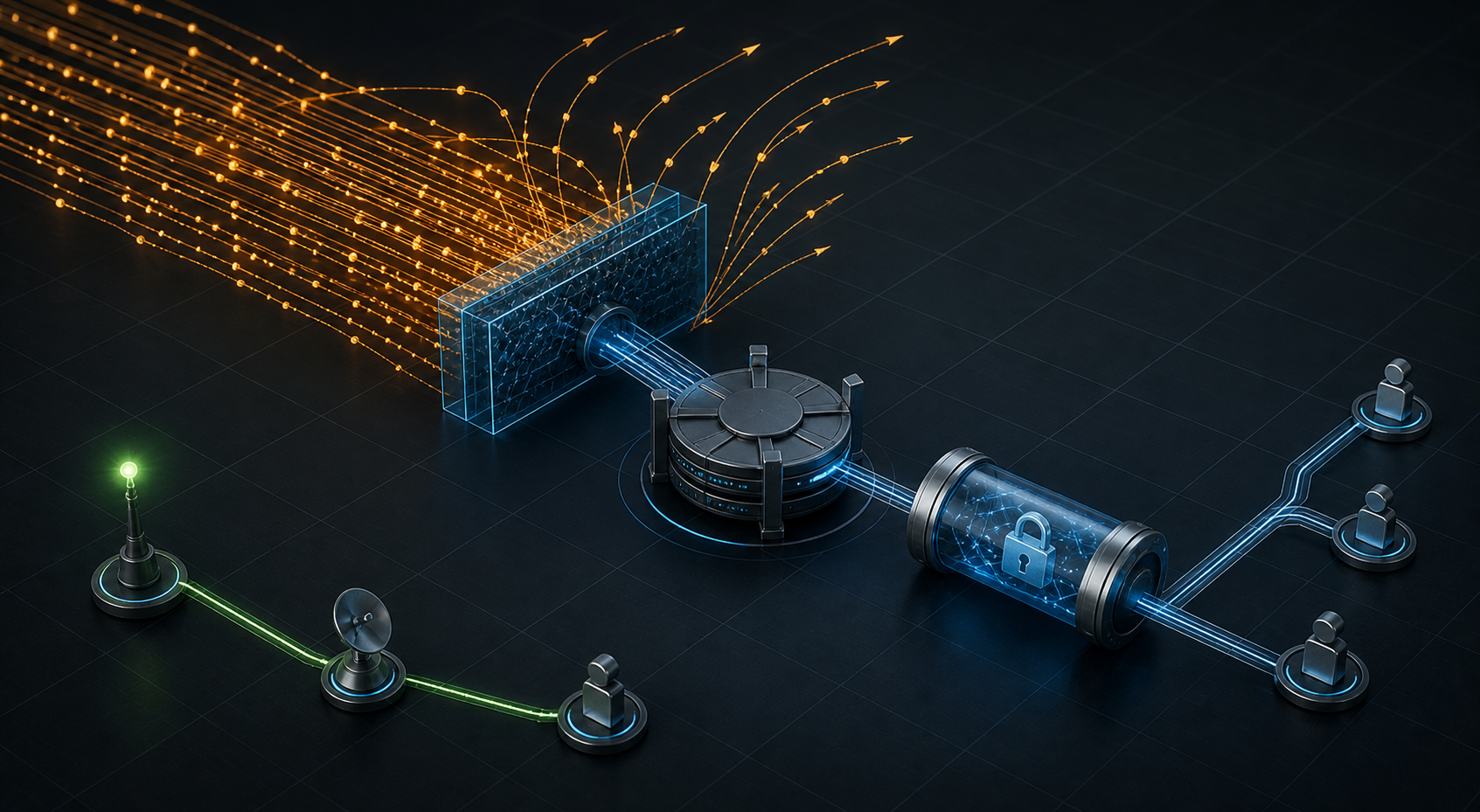
Threema says a series of large-scale DDoS attacks against it and colocation partner Nine caused a four-hour outage on Tuesday, August 11 and intermittent interruptions the next morning. Normal service returned at 12:23 p.m. CEST on August 12. Threema says it was unclear whether the messenger was the primary target or one of several targets, and it has not attributed the activity to an actor.
The incident is an availability failure, not evidence that Threema's end-to-end encryption was broken or message contents were exposed. It still matters for organizations that depend on the service during an emergency. Threema activated upstream filtering on August 14 and plans to add status history and RSS, but customers should test an independent notification path, define message-delay behavior, preserve local crisis contacts, and decide whether their backup channel shares providers, identity systems, networks, or devices with the primary one.
Key Takeaways
- check_circle Threema reports complete unavailability from 7:30 p.m. to 11:30 p.m. CEST on August 11, followed by intermittent interruptions on August 12 until normal operations returned at 12:23 p.m.
- check_circle The attacks targeted Threema and colocation partner Nine. Threema says it remains unclear whether its service was the primary target or part of a wider target set.
- check_circle Threema attributes the disruption to DDoS and does not report unauthorized system or data access. That preserves the confidentiality boundary but does not erase the availability impact.
- check_circle The public status page initially failed to update because of a separate technical issue and was temporarily taken offline, weakening the channel users needed to distinguish an outage from a local problem.
- check_circle Threema activated specialized upstream DDoS filtering on August 14. The vendor has not published attack volume, protocol mix, mitigation thresholds, affected components, or a service-level timeline by region.
- check_circle Threema OnPrem customers were not affected by this wave, according to the vendor, because they run separate infrastructure. Self-hosting changes the dependency owner rather than eliminating availability risk.
The Outage Timeline Is Clearer Than The Attack Attribution
Threema's August 14 postmortem places the main outage on Tuesday evening, August 11. The service was unavailable from 7:30 p.m. until 11:30 p.m. CEST. Large-scale DDoS activity resumed Wednesday morning, producing intermittent brief interruptions until normal operations were restored at 12:23 p.m. Threema says all services remained fully operational after that point. The current status page shows messaging, media and files, calls, Safe, Work management, Broadcast, Gateway, and the website as operational.
The vendor says the attacks continued over an extended period and changed patterns as defenders adapted. They targeted Threema and its colocation partner Nine. That shared target boundary matters because filtering and capacity at the hosting or transit layer can affect more than one application. Threema explicitly says it is not entirely clear whether the messenger was the main target or whether several targets were involved.
No responsible actor, motive, traffic volume, protocol distribution, botnet, ransom demand, or geographic source is confirmed in the postmortem. Threema notes that well-resourced actors can generate difficult attacks, including potentially state actors, but it does not attribute this event to a state. Reporting should stop at a sustained, adaptive DDoS campaign against the service and its colocation partner.
Encryption And Availability Protect Different Things
Threema says a denial-of-service attack targets availability and does not grant access to systems or data. For this incident, the company does not report message disclosure, key compromise, unauthorized account access, or an intrusion. That distinction is essential. A flood that prevents clients from reaching a relay does not by itself defeat the cryptography protecting a message. At the same time, a DDoS diagnosis is not a universal proof that no other activity occurred, so providers still need separate monitoring for authentication, application, and infrastructure anomalies.
Threema's documented design helps explain the boundary. Private keys are generated and kept on user devices. The server stores public keys and forwards end-to-end encrypted messages, while undelivered data may be held temporarily for asynchronous delivery and deleted after successful delivery. The whitepaper says the inner end-to-end encryption layer passes through the server without the server being able to remove it. Those properties protect content from the relay, not the route to the relay.
During an outage, messages may be delayed, calls may fail, group coordination may stall, and users may not know whether a send state reflects the recipient, their own network, or the provider. A confidential message that arrives after an evacuation decision can still be operationally useless. Security reviews for a messenger therefore need separate claims and tests for confidentiality, integrity, identity, metadata, endpoint safety, and availability.
The Status Channel Failed At The Moment It Was Needed
Threema says its status page was initially not updated because of a technical problem unrelated to the DDoS attack. The company temporarily took the page offline until that issue was resolved. Service updates instead went through social channels, while Threema Work customers received email Wednesday morning and account managers answered inquiries. Those measures provided useful alternatives, but they arrived across channels that customers may not monitor or may be unable to trust during a wider incident.
A status site is part of the incident system, not a marketing accessory. It should be hosted and operated far enough from the production service that the same edge, identity provider, DNS zone, deployment pipeline, administrator access path, or capacity event does not silence both. Update authorization needs its own strong controls so attackers cannot turn an outage into a false recovery notice or malicious instruction. Subscribers also need a feed that does not depend on opening the affected app.
Threema says it will add incident history and an RSS feed to the status page. That is a useful improvement because history supports post-incident accountability and RSS offers machine-readable updates. Organizations should still ingest the feed into a separate monitoring and paging system, document the official domains and sender identities in advance, and forbid recovery instructions that ask users to weaken device security or disclose secrets.
Upstream Filtering Changes The Defensive Boundary
Threema activated specialized upstream DDoS protection in production at 6:05 p.m. CEST on August 14 after final stability testing. Upstream filtering is valuable because malicious traffic can be discarded before it consumes the target's own links and infrastructure. CISA, the FBI, and MS-ISAC similarly recommend coordinating with Internet and hosting providers, enabling mitigation services, filtering traffic, preserving evidence, and designing high-availability or load-balanced systems around critical services.
The change introduces questions the public postmortem does not answer. Threema has not named the mitigation provider, described which traffic is visible to it, published false-positive handling, explained fail-open or fail-closed behavior, or stated how the filter interacts with all messaging, call, media, Gateway, and management endpoints. Those gaps do not imply a problem. They are the validation work that follows any emergency edge change, especially for a privacy-sensitive service.
Operators should measure more than uptime. Useful evidence includes legitimate connection success by client version and region, message-queue age, call setup success, media delivery, retry behavior, filter challenges, dropped traffic, and time to change a mitigation rule. Capacity exercises should test an attack that shifts protocol or endpoint rather than repeating one known packet pattern. The goal is to preserve legitimate service while the attack changes.
OnPrem Avoided This Wave But Transfers The Availability Job
Threema says OnPrem customers were unaffected because their installations use their own infrastructure. That separation is a genuine failure-domain difference. It does not mean OnPrem is automatically more available. The customer becomes responsible for Internet edges, capacity, filtering, load balancing, monitoring, upgrades, backups, staff, physical sites, and the dependencies needed by mobile and desktop clients.
An air-gapped or internal deployment can be appropriate for a closed organization, while an Internet-reachable deployment still needs DDoS engineering. Buyers should compare the hosted and self-managed models using evidence: topology, provider diversity, recovery objectives, attack-mitigation capacity, update ownership, status-channel independence, and results from exercises. The August incident shows one hosted dependency path; it does not establish that every private deployment would have survived the same traffic or adapted faster.
A stronger follow-up from Threema would publish per-service impact, queue and delivery behavior during the outage, regions or client populations affected, the status-page root cause, attack classes at a safe level of detail, mitigation activation times, and validation results after upstream filtering. Customers do not need the botnet's full playbook. They need enough evidence to update risk models, tune alerts, and decide whether their communication-continuity design matches the service they actually received.
Checklist
- Record the August 11 and 12 outage in communication-risk and supplier registers, including which teams, workflows, calls, messages, and integrations were affected locally.
- Subscribe to Threema's status updates when RSS becomes available and route them into monitoring that does not depend on Threema itself.
- Pre-enrol users in an alternate communication channel and store its activation instructions and verified contact list offline or on independently available systems.
- Map shared dependencies across the primary messenger, fallback channel, status page, identity provider, mobile carrier, push services, DNS, devices, and administrators.
- Define what information is safe to send through the fallback channel, how recipients authenticate urgent instructions, and how conflicting messages are resolved.
- Run a timed exercise with the primary messenger unavailable, then test delayed-message reconciliation and the return to normal service.
- Ask the provider or internal OnPrem team for evidence on DDoS mitigation, queue behavior, status-channel independence, capacity testing, recovery objectives, and incident history.
Sources
- Threema: DDoS attacks and August 2026 outage postmortem open_in_new
- Threema: public system status open_in_new
- Threema: data stored by the service open_in_new
- Threema: cryptography whitepaper open_in_new
- Threema: OnPrem architecture and deployment model open_in_new
- Threema: business continuity communication guidance open_in_new
- CISA, FBI, and MS-ISAC: understanding and responding to DDoS attacks open_in_new
Continue Reading
Ray Exploitation Turns Local Dashboards Into An Incident Boundary
CISA lists Ray CVE-2025-62593 as exploited. Firefox or Safari can bridge a malicious page to an unpatched local dashboard and execute code.

GitLab GraphQL Flaws Put Public Project Integrity At Risk
GitLab fixed an unauthenticated GraphQL path that could modify or delete public projects. Self-managed operators need a verified upgrade and evidence plan.
SafePal Order-Data Breach Turns Shipping Details Into Wallet Lures
SafePal says an order-tracking authorization flaw exposed 39,798 customers. Wallet keys were not breached, but purchase data sharpens phishing risk.