Trezor Shipping Breach Turns Order Data Into Wallet Risk
Trezor says ShipMonk exposed contact and address data for 13,689 customers. Devices and keys remain safe, but targeted phishing risk has changed.
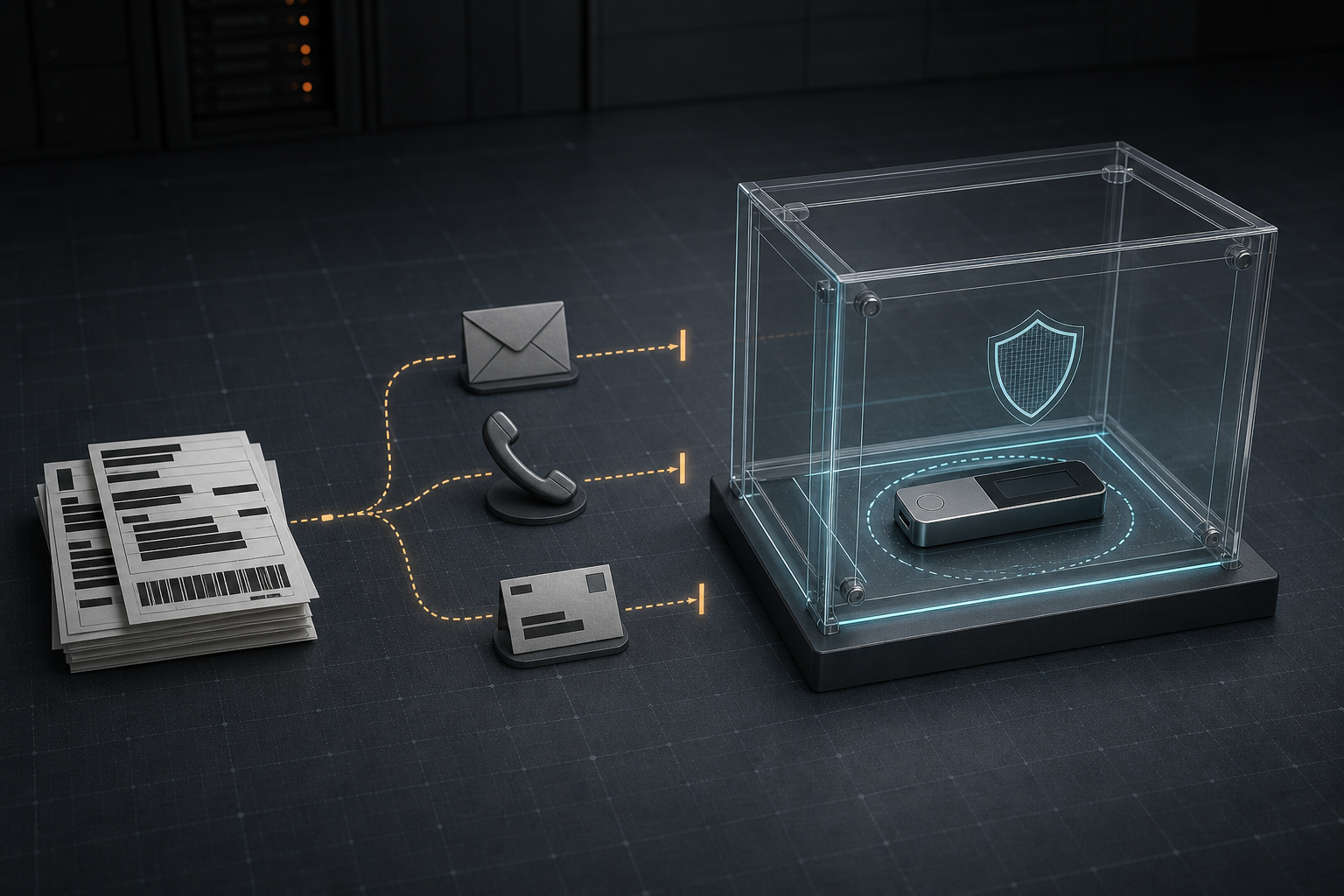
Trezor disclosed on August 13 that ShipMonk, one of its shipping providers, experienced unauthorized access to systems containing customer order data. The company says 11,742 customers had their name, email address, phone number, and shipping address exposed. Another 1,947 had their name, city, and email address exposed, bringing the total to about 13,689. Trezor says its own systems, hardware wallets, private keys, and wallet backups were not affected.
The immediate risk is targeted social engineering, not a technical failure of the wallet. An attacker can combine a real name, order context, phone number, and address to make email, phone, text, or postal contact sound credible. Affected customers should treat unsolicited support, firmware, backup-verification, KYC, and device-deactivation messages as hostile. They should not move funds merely because contact data leaked, but anyone who has entered a wallet backup online or shared it must move funds to a new wallet with a new backup through a verified process.
Key Takeaways
- check_circle Trezor says approximately 13,689 customers were affected through shipping provider ShipMonk.
- check_circle The larger group lost names, email addresses, phone numbers, and shipping addresses; the smaller group lost names, cities, and email addresses.
- check_circle Trezor says its systems, devices, private keys, and wallet backups were not compromised.
- check_circle The disclosure raises phishing and impersonation risk across email, phone, text, and postal mail rather than proving wallet access.
- check_circle Trezor has not publicly established the attacker's initial access method, full access timeline, or use of the exposed data.
- check_circle A contact-data breach alone is not a reason to rotate a wallet, but a wallet backup entered online or shared with another person must be treated as compromised.
The Disclosure Establishes A Narrow But Serious Boundary
Trezor says ShipMonk informed it on Monday, August 10, of unauthorized access to systems holding customer data. Trezor published its notice on August 13 and says ShipMonk secured the affected systems and hardened its security. The investigation remains ongoing. The public notice does not give an intrusion date, dwell time, initial access method, attacker identity, or a technical account of how records were accessed.
The confirmed data scope has two groups. For 11,742 customers, exposed fields were name, email address, phone number, and shipping address. For another 1,947, the fields were name, city, and email address. Trezor says the primary order window covered deliveries in the United States, United Kingdom, Sweden, Colombia, Brazil, Italy, and Portugal between May 10 and August 8. Its update cautions that the smaller partial-exposure group may include older orders, and says it is verifying the timeframe with ShipMonk.
Trezor says all affected customers were contacted separately from its help@trezor.io address and that people who did not receive that notice are not affected. That is the vendor's current determination, not a general test that an email sender can prove. Email display names and sender addresses can be imitated. Customers should use the published incident page as the source of record and expect its answers to change as the investigation resolves the older-order exception.
A Safe Device Does Not Make Order Data Harmless
The breach boundary matters. Shipping data does not contain a wallet backup, private key, PIN, passphrase, device firmware, or account balance. Trezor says its systems and devices were not compromised. An affected person does not need to assume that an attacker can sign transactions merely because a shipping provider exposed an order record.
The same record can still improve a scam. A caller can use the recipient's real name and location, an email can refer to a recent hardware-wallet delivery, and a letter can arrive at the correct physical address. Those details reduce the obvious inconsistencies people often use to reject a lure. Trezor warns that scammers may impersonate the company, a bank, or a crypto exchange and may contact people by email, phone, or post.
An order record also suggests interest in self-custody, but it does not prove that the recipient still owns a device, holds cryptocurrency, or controls a large balance. Response should be proportionate and discreet. Affected customers can tell household members not to discuss assets with unexpected visitors or callers, review how deliveries and mail are handled, and use local authorities if a communication becomes threatening. The public evidence does not establish a physical attack campaign.
Verify The Message Without Following Its Path
A convincing phishing message often supplies both the problem and the path to solve it. It may include a support number, QR code, download, browser link, or remote-assistance request. Do not use those paths. Open a previously bookmarked Trezor page or type the known domain independently, then navigate to the incident notice or official support. A search advertisement, shortened link, and sender-provided telephone number do not provide independent verification.
Trezor says it will never ask for a wallet backup, PIN, password, or code. It also says claims that a device will be deactivated unless the user completes a security action are scams. A message can quote correct personal data and still be fraudulent. Urgency, accurate order details, polished writing, and a familiar logo do not change the rule that the wallet backup never belongs in a website, chat, email, form, or call.
Software should come from the official Trezor Suite download page or the project's official GitHub releases. Trezor provides a separate verification guide for checking desktop downloads. Existing users should initiate legitimate firmware and Suite updates inside the desktop application, not through an unsolicited message. This separates a normal maintenance action from the attacker's chosen delivery channel.
Do Not Rotate A Wallet Solely Because Contact Data Leaked
Moving cryptocurrency creates fees, new addresses, new backup material, and another opportunity to send to the wrong destination or expose a secret. Trezor's notice says the wallet boundary held. If the only confirmed event is exposure of contact and shipping data, there is no technical reason in the disclosure to wipe a device, create a new backup, install emergency firmware, or transfer funds.
The decision changes if a person followed a lure and typed a wallet backup online, sent it to anyone, stored a new digital copy, or otherwise believes another party obtained it. Trezor's recovery guidance says to assume a suspected backup compromise is real and move funds promptly to a wallet with a new backup. That is a separate incident-response workflow that should be performed from verified software and instructions. The old backup must not be reused after the move.
Contact accounts deserve their own review. Secure the email account that receives wallet notices with a unique password and phishing-resistant authentication where available. Check recovery methods and active sessions. Ask the mobile carrier about protections against unauthorized number transfer. Those steps do not alter the blockchain wallet, but they make it harder to turn exposed contact data into control of email, phone, exchange, or recovery accounts.
Response Must Cover Email, Phone, And Postal Lures
The likely lure set is broader than a fake login page. Treat requests to verify a backup, run a memory test, install a security patch, complete KYC, reverse a transaction, confirm a delivery, or prevent device deactivation as suspect when they arrive unexpectedly. Never read backup words over the phone, photograph them, type them into a computer, or give a caller control of the screen.
People who manage family, treasury, or organizational wallets should brief every person who can receive mail, answer the relevant phone, approve a transaction, or access the backup. A well-trained signer can still be undermined by a colleague who forwards a convincing notice. Establish one verified channel for wallet support and require a second person to review unusual recovery or transfer requests before any device is connected or transaction is signed.
Preserve suspicious messages before deleting them. Record the sender, headers where available, phone number, envelope, requested action, destination domain, and any cryptocurrency address. Do not visit a suspicious domain merely to investigate it. Report the attempt through Trezor's official support and through the relevant email, telecom, financial, or local reporting channel. Evidence from several channels can reveal a coordinated campaign that one message alone would not.
Retention Helped, But The Supplier Boundary Needs Proof
Trezor's privacy documentation says e-shop fulfillment data is retained for 90 days and that fulfillment partners must delete or anonymize it after that period, subject to order-related exceptions. The company credits this policy with limiting the incident. The partial-exposure update shows why a written period also needs operational proof: Trezor is still determining why some older name, city, and email records may have remained in ShipMonk's environment.
For wallet vendors and other companies shipping sensitive products, minimization should cover every field and every copy. Teams should document which provider needs a phone number or email address, when each field leaves the merchant, where replicas and analytics systems exist, how deletion is verified, and what happens to exception records. Contract language is useful, but deletion logs, sampling, access reviews, and incident exercises provide stronger assurance that the supplier follows the intended boundary.
Several important facts remain unknown: when unauthorized access began, how the actor entered ShipMonk, which systems and backups were reached, whether other merchants were involved, how much data was exfiltrated, and whether the information has been distributed or used. Until Trezor or ShipMonk publishes those answers, defenders should not attach an unconfirmed exploit, actor, or campaign to the incident. The practical response can proceed from the confirmed field list without inventing a root cause.
Checklist
- Check for Trezor's notification, then verify the incident independently on the official Trezor site.
- Reject every unsolicited request for a wallet backup, PIN, passphrase, password, code, download, or remote session.
- Use only the official Trezor Suite page or official GitHub releases for software, and verify desktop downloads.
- Secure the affected email and phone accounts, review recovery paths, and watch for account-session changes.
- Brief household members and co-signers about convincing email, phone, text, and postal impersonation.
- Do not rotate the wallet for contact-data exposure alone; move funds only if the backup or signing authority may be compromised.
- Preserve and report suspicious communications without visiting attacker-provided links or calling supplied numbers.
Sources
- Trezor disclosure: recent customer data exposed in shipping provider incident open_in_new
- Trezor privacy policy for order and fulfillment data open_in_new
- Trezor guidance on scams and phishing open_in_new
- Trezor Suite download and verification guide open_in_new
- Trezor guidance for using and protecting a wallet backup open_in_new
- Trezor process for moving funds to a wallet with a new backup open_in_new
- Trezor response guidance for unauthorized transactions open_in_new
Continue Reading

Zoom Annotation RCE Makes Meeting Membership An Endpoint Boundary
Zoom patched annotation flaws that could let one meeting participant attack another. Admins need version proof across clients, Rooms, VDI, and SDKs.

WPManageNinja Update Compromise Requires More Than A Clean Plugin
A forgotten WPManageNinja server served tampered plugin updates. Clean files alone do not remove persistence, administrator access, or stolen credentials.

Reported vCenter Exploitation Puts The Management Plane In Incident Scope
QUIRSO reports exploitation of vCenter CVE-2026-59310 for reverse SSH access. Patch affected branches and investigate the appliance as a control plane.