Fable 5 Suspension Makes AI Safety A Deployment-Control Issue
Anthropic says a US government directive forced it to disable Fable 5 and Mythos 5 after a narrow jailbreak concern. The practical lesson is access design, retention policy, and fallback planning.
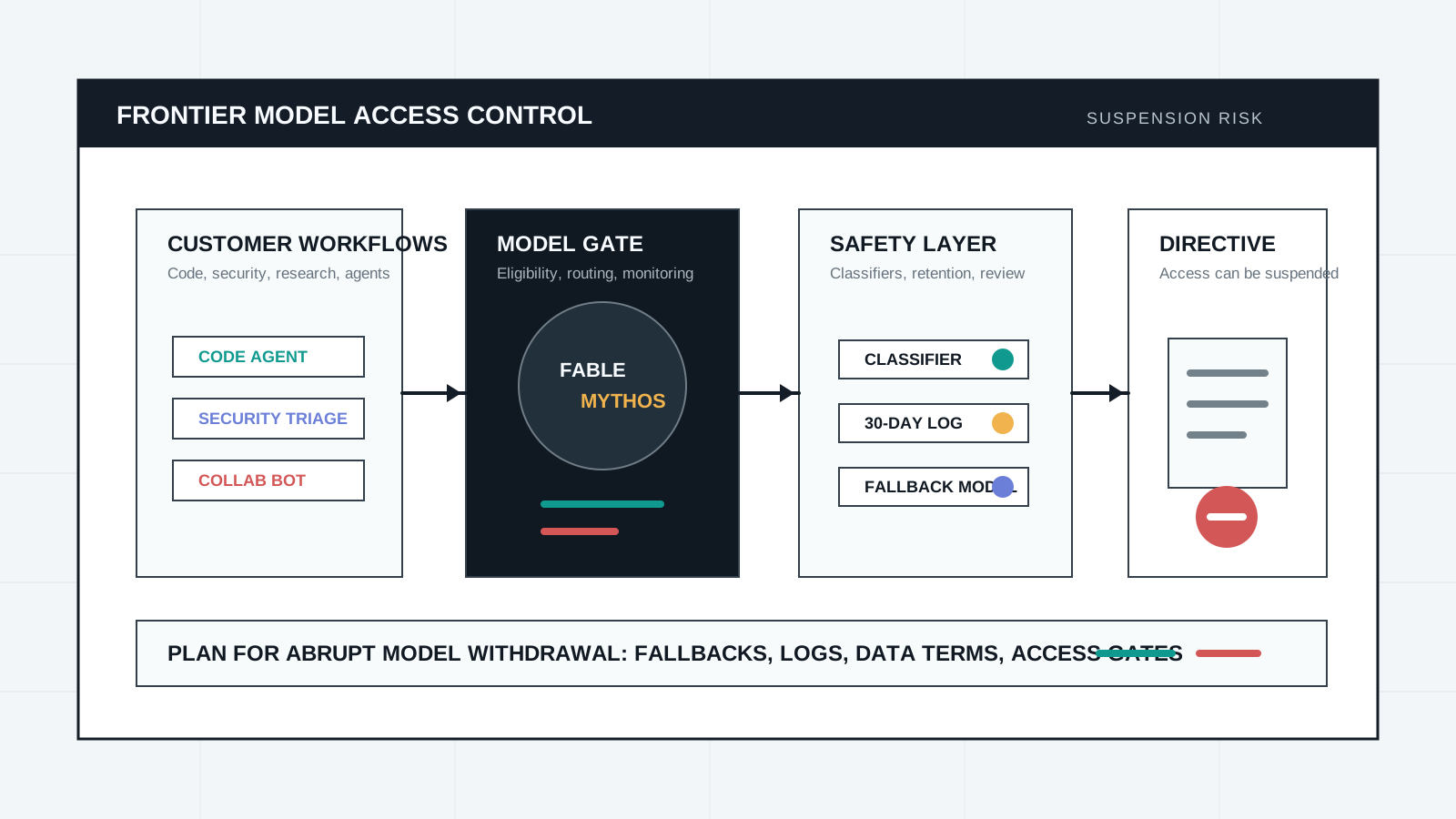
Anthropic said on June 12, 2026 that it had received a US government export-control directive requiring suspension of all access to Claude Fable 5 and Claude Mythos 5 by any foreign national, including foreign national Anthropic employees. Anthropic says the practical effect was broader than that target: it had to disable both models for all customers to comply. Access to other Anthropic models was not affected.
The public record is still thin. Anthropic says the government letter did not give specific details, and that the company understands the concern to involve a narrow technique for bypassing Fable 5 safeguards. Anthropic says the demonstration it reviewed identified only a small number of previously known, minor vulnerabilities, and that other public models could find them without the bypass. AP reported that the Commerce Department did not immediately respond to a request for comment. Until a public directive, technical report, or follow-up appears, buyers should treat the strongest evidence as Anthropic's statement plus independent reporting that the models were taken offline.
Key Takeaways
- check_circle The confirmed public fact is Anthropic's statement that Fable 5 and Mythos 5 access was suspended after a US government directive; the directive itself is not public.
- check_circle Teams using frontier models for coding, security triage, research, or workflow automation need a plan for abrupt model withdrawal.
- check_circle Fable 5 and Mythos 5 are the same underlying model class, but Anthropic described Fable as the broadly available version with safeguards and Mythos as trusted-access capability for selected defenders and researchers.
- check_circle A narrow, non-universal jailbreak is different from a universal bypass; governance decisions should preserve that distinction.
- check_circle Anthropic's 30-day retention policy for Mythos-class traffic makes data handling part of the safety model, not a side note.
- check_circle Enterprise customers should document fallback models, retained data paths, regional access assumptions, and what happens when safety classifiers route work to a different model.
What Anthropic Says Happened
Anthropic's statement says it received the directive at 5:21pm ET on June 12. The company says the order, citing national security authorities, required it to suspend Fable 5 and Mythos 5 access for foreign nationals inside and outside the United States, including foreign national employees. Anthropic says it disabled access for all customers because that was the only way to ensure compliance quickly. The company also said other Anthropic models were unaffected.
Anthropic disputes the technical basis it understands to be behind the action. According to the statement, the government did not provide specific details of the national security concern. Anthropic says it believes the concern involves a way of bypassing, or jailbreaking, Fable 5. The company says it reviewed a demonstration of the technique being used to identify a small number of previously known, minor vulnerabilities, and says the same capability is widely available from other public models. That is Anthropic's characterization. There is no public government technical analysis to compare against yet.
Why The Shutdown Matters
The interesting part for Protocol Report readers is not only that a model went offline. It is that model access has become an operational dependency that can be changed by safety policy, export control, provider risk decisions, and government process. Teams that put a frontier model into coding agents, security review, incident triage, Slack workflows, internal support, or regulated document analysis are no longer only buying model quality. They are buying a governed service with rules that may change under pressure.
That means reliability planning has to include safety and legal availability. If a model can disappear from API routing, agent workflows need a known fallback. If a high-capability model silently routes certain requests to a lower-capability model, users need telemetry that says which model answered. If data retention changes for a model class, the privacy and security review has to happen before the first sensitive prompt is sent. These are deployment controls, not after-the-fact policy footnotes.
Fable And Mythos Are Access Tiers
Anthropic launched Claude Fable 5 and Claude Mythos 5 on June 9. In that launch post, Anthropic described Fable 5 as a Mythos-class model made safe for general use. The same post described Mythos 5 as the same underlying model with safeguards lifted in some areas for a small group of cyberdefenders and infrastructure providers, initially through Project Glasswing and a broader trusted-access program later.
That distinction matters because it turns model naming into an access-control architecture. Fable is meant to expose most of the capability while routing some cyber, biology, chemistry, and distillation-related requests through Claude Opus 4.8 instead. Mythos is meant for trusted defensive work where those same restrictions would block legitimate security or research activity. In other words, the product boundary is not just model weights. It includes classifiers, routing, user eligibility, monitoring, and retention.
Jailbreak Claims Need Precision
Anthropic's own research and launch material accepts that perfect jailbreak resistance is not currently realistic. Its January work on Constitutional Classifiers says large models remain vulnerable to jailbreak techniques, while describing classifier systems intended to reduce successful attacks and make broad bypasses harder. The Fable launch post said external and internal testing had not found a universal jailbreak, while acknowledging that narrow jailbreaks are likely across the industry.
That vocabulary is important. A universal jailbreak would broadly defeat safeguards across many harmful tasks. A narrow jailbreak may only work in specific circumstances or for a limited class of prompts. Narrow does not mean irrelevant, especially if an attacker can automate attempts across many requests. But it should not be treated the same as a complete loss of control. The public disagreement appears to sit exactly there: whether a narrow bypass related to software flaw finding is enough to recall a commercial model from all customers.
Retention Became Part Of The Safety Model
The Fable and Mythos launch also introduced a data-retention change for Mythos-class models. Anthropic's support article says prompts and outputs for Mythos-class models are retained for 30 days for trust and safety purposes on every platform where those models are offered. The change applies to organizations that otherwise use zero data retention in Claude Console, Claude Code Enterprise, Amazon Bedrock, Google Cloud Agent Platform, or Microsoft Foundry. Anthropic says other models remain under current terms.
Anthropic frames retention as a control for attacks that only appear across many requests, such as repeated jailbreak attempts or larger misuse patterns. That may be a defensible safety argument, but it changes the data-risk profile for customers. A security team that previously approved zero-retention use of a coding assistant cannot assume the same policy applies to every higher-capability model. Procurement, privacy, security, and engineering need a shared table of which models retain what, where review happens, which platform stores the data, and how quickly access can be disabled.
What Teams Should Do Now
First, inventory where high-capability models sit in real workflows. Include API calls, Claude Code, browser agents, Slack or Microsoft 365 integrations, internal support bots, code-review agents, vulnerability triage, and research notebooks. For each workflow, record the model, provider, region, account owner, data class, retention terms, fallback model, and whether output is allowed to trigger an action without human review.
Second, separate model choice from workflow authority. A coding agent should not gain production credentials just because a stronger model becomes available. A security triage assistant should not be able to file fixes, notify customers, or change access controls without a review gate. A community or collaboration bot should log which model produced a moderation or trust-and-safety recommendation. If a provider changes routing from one model to another, the workflow should degrade visibly, not quietly.
Third, define a model-withdrawal runbook. It should say who decides whether to pause an automation, which model or provider can replace the suspended one, which tests must pass before fallback use, and which customers or internal teams need notice. This is the same discipline teams already use for identity providers, payment processors, cloud regions, or email delivery. Frontier AI is now critical infrastructure for some teams, and it deserves the same boring operational paperwork.
What To Watch Next
Anthropic said it would share more detail over the next 24 hours and was working to restore access. The next useful evidence would be a public government explanation, a technical description of the alleged bypass, Anthropic's follow-up analysis, or a revised access path that distinguishes US persons, foreign nationals, enterprise customers, employees, and trusted-access users. Without that, broad claims about the directive's technical merit or political motive are premature.
The larger governance question will remain even if access is restored quickly. Anthropic has publicly argued that governments should be able to block unsafe deployments through a transparent statutory process grounded in technical facts. Its complaint is that this action did not meet that standard. The industry now has a live test case for whether advanced-model governance can be fast, technically specific, fair to customers, and usable during a real deployment dispute.
Checklist
- Inventory all workflows that depend on Fable 5, Mythos 5, or another frontier model class.
- Record the fallback model and expected quality loss for coding, security, research, and agent workflows.
- Verify whether any workflow uses a model class with 30-day retention instead of zero data retention.
- Log the actual model used for each high-risk action, including fallback routing and classifier-triggered changes.
- Keep production credentials, repository write access, customer messaging, and moderation actions behind separate approval gates.
- Create a model-withdrawal runbook for provider outages, export controls, safety recalls, and policy changes.
- Wait for primary technical evidence before treating a reported narrow jailbreak as a universal model failure.
Sources
- Anthropic: Statement on the US government directive to suspend access to Fable 5 and Mythos 5 open_in_new
- Anthropic: Claude Fable 5 and Claude Mythos 5 open_in_new
- Claude Help Center: Data retention practices for Mythos-class models open_in_new
- Anthropic: Project Glasswing open_in_new
- Anthropic: Next-generation Constitutional Classifiers open_in_new
- Anthropic: Policy on the AI Exponential open_in_new
- Anthropic: Updated Responsible Scaling Policy announcement open_in_new
- AP: Anthropic says it has taken its latest AI models offline open_in_new
Continue Reading

Chrome's V8 Zero-Day Turns Browser Patch Lag Into Session Risk
Google patched an exploited V8 flaw in Chrome 149.0.7827.102/.103. The practical work is managed relaunch, session review, and treating browser patch lag as identity exposure.

Oracle PeopleTools RCE Puts HR Portals On The Fast Patch List
Oracle's June 10 alert for CVE-2026-35273 affects PeopleTools 8.61 and 8.62 and is remotely exploitable without authentication. Exposed PeopleSoft portals need fast patching and forensics triage.
YellowKey Puts BitLocker Back On The Physical-Access Checklist
Microsoft and NVD records for YellowKey put BitLocker risk back on the physical-access checklist. Patch, review TPM-only devices, and reserve TPM+PIN for laptops that leave controlled spaces.