Private Community Invite Links Are Access Tokens
Invite links for Discord, Slack, Telegram, WhatsApp, Signal, and other community tools behave like bearer credentials. Private groups need expiry, approval, rotation, and offboarding rules.
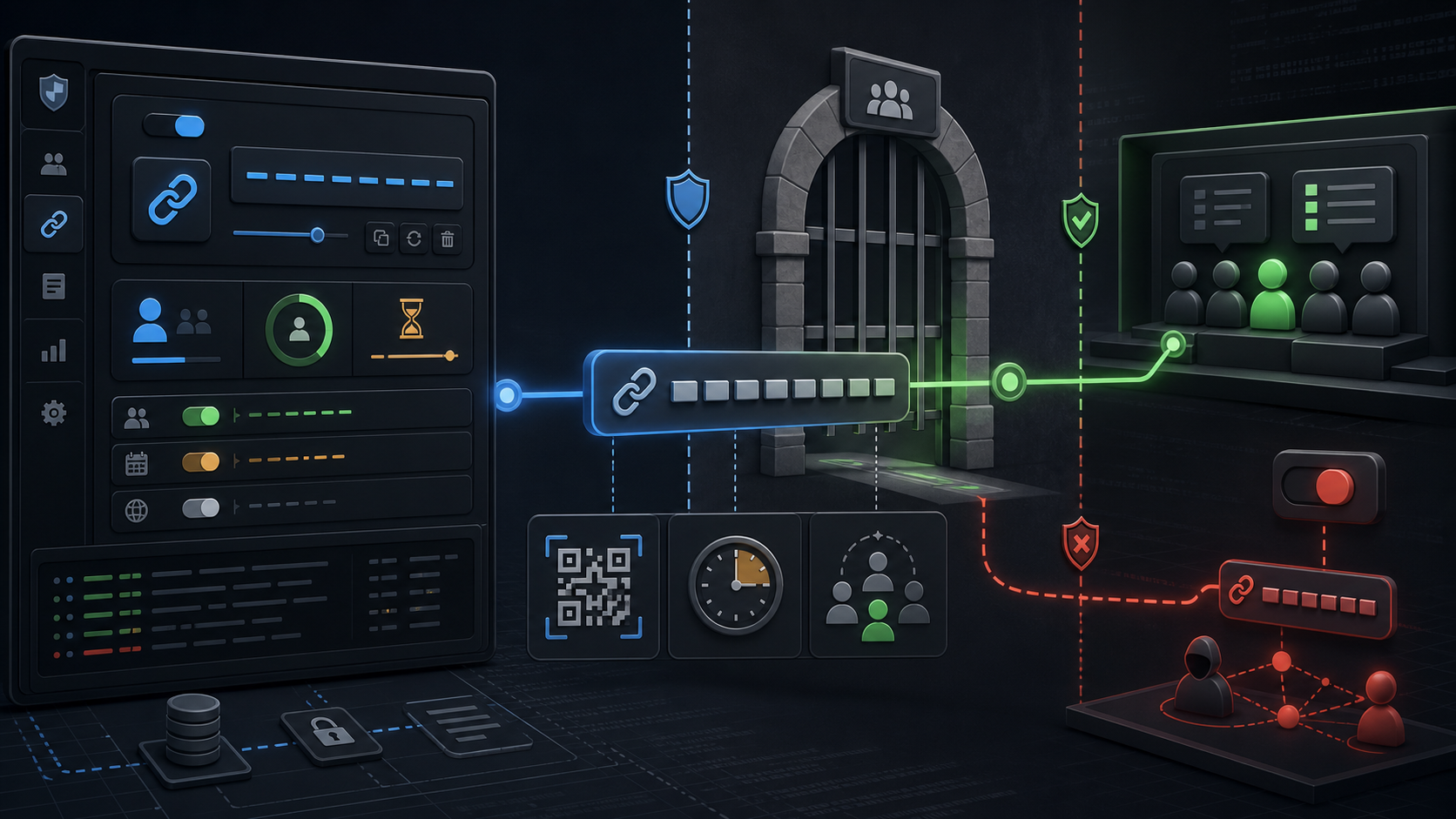
An invite link is not just a convenience URL. In many community platforms it is a bearer credential: whoever receives it can attempt to enter a room, server, workspace, or group unless an administrator has added expiration, use limits, approval, domain restrictions, or another guardrail.
The risk is practical rather than exotic. Links get pasted into public posts, forwarded by helpful members, stored in CRM notes, indexed by ticket systems, leaked through screenshots, reused after an event, or kept alive after a partner leaves. Private communities should manage invite links with the same discipline they already apply to bot tokens and webhook URLs.
Key Takeaways
- check_circle Invite links should have owners, purpose, expiration, and rotation dates.
- check_circle Admin approval is the safer default for sensitive rooms because possession of a link does not prove identity or authorization.
- check_circle Permanent links are appropriate only for intentionally public onboarding surfaces.
- check_circle Offboarding should include invite-link review, not only role removal and account deactivation.
- check_circle QR codes and short links are still invite links and need the same controls.
- check_circle A public launch can use broad links temporarily, but the community should narrow access once the migration or event is over.
Bearer Links Need Ownership
A bearer credential grants power to whoever holds it. That is how many invite links behave. A Discord server invite, Slack workspace invite link, Telegram group link, WhatsApp group link, Signal group link, or private forum link may not reveal a password, but it can move a person to the front door of a trusted space. If the platform automatically admits link holders, the link is even closer to a credential. If the platform requires approval, the link still becomes a discoverable route into the community.
The control starts with ownership. Every active invite link should have an owner, audience, channel, creation date, expected lifetime, and reason. A link created for a partner launch should not quietly become the permanent onboarding path for paying members. A link created for a conference should not remain valid months later. A link shared with a moderator candidate should not be reusable by a different person after the candidate declines.
Expiry And Use Limits
Expiration is the simplest way to reduce link drift. Discord's invite documentation describes controls such as expiration and maximum uses. Telegram has long supported group invite links, and modern group tools commonly add options such as join requests, QR codes, and different links for different campaigns. Slack's member invitation workflow separates normal invitations from broader workspace joining policy. The exact feature names differ, but the principle is the same: a link without an end date will eventually escape the context that made it safe.
Use limits are especially useful for events, customer migrations, beta programs, and paid communities. A one-use or small-batch link gives administrators a narrow failure radius. If the link appears in the wrong place, the damage is bounded. If a large public migration needs an open link, label it as a launch artifact and schedule its retirement before the community starts discussing sensitive material.
Approval Is The Identity Check
Possession of a link is weak evidence. A member may forward it to a friend. A contractor may paste it into a support ticket. A screenshot may show a QR code. A short link may be reused after a campaign. If the community is sensitive, admin approval is the identity check that turns a URL into a controlled onboarding flow.
Approval does not have to be heavy. A moderator can compare the requested account against a payment record, email domain, event registration, customer profile, wallet verification, or known referral path. For high-risk rooms, approval should also include a short waiting period or secondary confirmation. The goal is not to make membership painful. The goal is to avoid treating a copied link as proof that the person holding it belongs in the room.
Offboarding And Rotation
Most communities remember to remove departed members from roles. Fewer remember to rotate the links those members could still forward. Offboarding should include a quick invite inventory: active links, public landing pages, partner links, QR codes in old slide decks, support macros, onboarding emails, and pinned messages. If a person had administrator access, assume they may have created links that other admins do not know about.
Rotation should be routine after sensitive events. Rotate links when a moderator leaves under tension, a paid cohort ends, a partner contract closes, a scam campaign targets members, or an invite appears in public. The new link should not be pasted into the same uncontrolled surfaces that leaked the old one. If a platform allows multiple links, keep separate links for separate audiences so a leak can be traced and contained.
Public Launches And Scam Surfaces
Open invite links are not always wrong. They are useful for public communities, launch events, customer onboarding, game guilds, open-source contributor rooms, and large migrations. The mistake is keeping the launch posture after the launch is over. Once a group starts handling support disputes, payment details, moderation reports, bug reports, safety concerns, or partner information, the invite model should tighten.
Scammers also use invite links as credibility props. A fake support account can send a real-looking group link. A public directory can collect links that were meant for a smaller audience. A compromised moderator account can distribute an invite to a phishing room whose name looks similar to the real community. Users need clear official entry points, and administrators need a process for reporting, revoking, and replacing abused links.
Platform-Specific Baselines
Discord communities should avoid permanent invites for private servers and should pair sensitive channels with role review. Slack workspaces should use workspace invitation policy, single-channel guests, domain rules, and administrator review where the workspace carries business data. Telegram and WhatsApp groups should reset invite links when they drift outside the intended audience, and groups should use admin approval or private distribution for sensitive membership. Signal groups should use group-link settings and approval controls for rooms where member identity matters.
The common baseline is simple: no permanent private invite without a reason, no high-risk room without approval, no migration link without a retirement date, and no offboarding process that ignores live links. This does not require enterprise tooling. It requires treating community access as operational infrastructure instead of a casual URL.
Checklist
- Name an owner and purpose for every active invite link.
- Set expiration and maximum-use limits unless the link is intentionally public.
- Require admin approval for private, paid, operational, legal, finance, safety, source, and wallet-related rooms.
- Keep separate links for separate campaigns or partners so leaks are traceable.
- Review invite links during moderator, contractor, partner, and employee offboarding.
- Rotate links after public leaks, scam campaigns, tense departures, and completed events.
- Publish one official onboarding path so members can distinguish real invites from scam rooms.
Sources
- Discord Support: Invites 101 open_in_new
- Discord Support: Setting Up Permissions FAQ open_in_new
- Slack Help Center: Invite new members to your workspace open_in_new
- Slack Help Center: Manage guests in Slack open_in_new
- Telegram Blog: Migrating Existing Group Chats to Telegram open_in_new
- WhatsApp Help Center: How to invite someone to a group open_in_new
- OWASP Cheat Sheet Series: Secrets Management open_in_new
Continue Reading
SearchLeak Makes Enterprise AI Search A Data Egress Path
Varonis says Microsoft patched CVE-2026-42824 after a SearchLeak vulnerability chain in Microsoft 365 Copilot Enterprise Search. The durable lesson is permission hygiene and output control.
Encrypted Chat Backups Move Privacy To Recovery
End-to-end encrypted messages can become recoverable cloud archives through backups, linked devices, exports, and account recovery. Sensitive groups need a backup policy, not only a chat app policy.

Chrome's V8 Zero-Day Turns Browser Patch Lag Into Session Risk
Google patched an exploited V8 flaw in Chrome 149.0.7827.102/.103. The practical work is managed relaunch, session review, and treating browser patch lag as identity exposure.