Push Notifications Make Secure Chat A Platform Boundary
End-to-end encrypted chat still depends on APNs, Firebase Cloud Messaging, lock-screen settings, and app payload choices. Review notification payloads as privacy infrastructure.
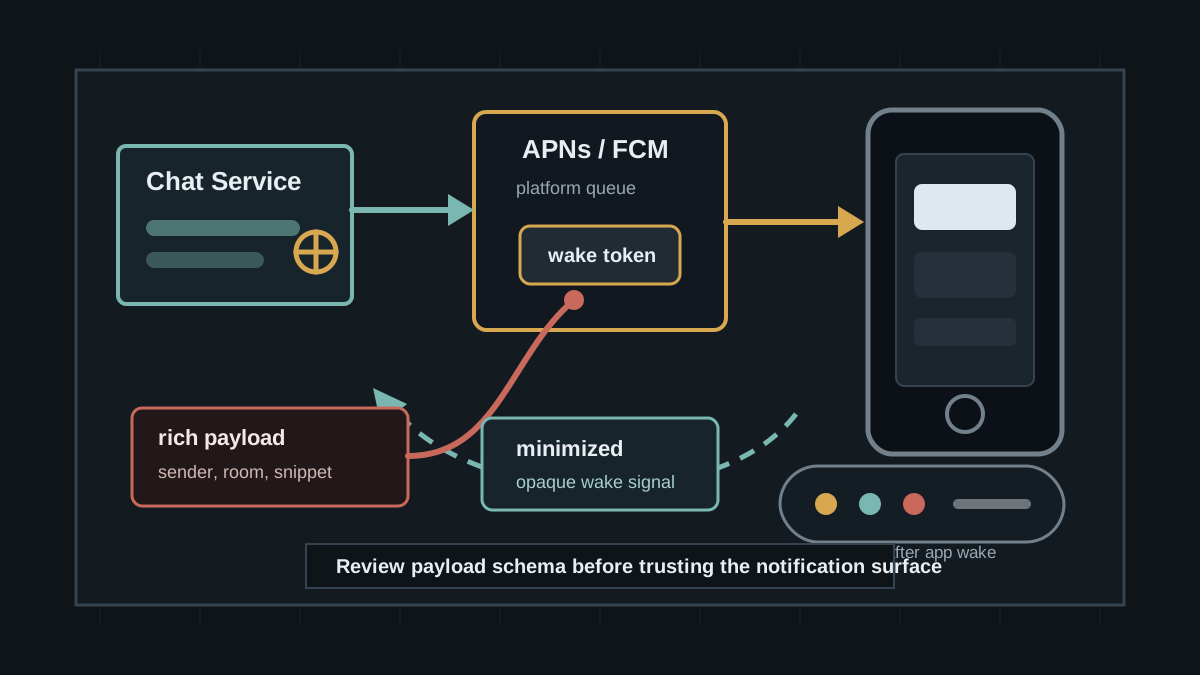
Secure chat systems can protect message transport and still leak useful context through notifications. A phone needs to wake up when a message arrives, and most mobile apps do that through platform push services such as Apple Push Notification service or Firebase Cloud Messaging. The privacy result depends on what the app puts in the payload, what the operating system displays, and what the app later fetches from its own server.
A 2024 PETS paper found that several secure messaging apps sent metadata, and in some cases message content, through Firebase Cloud Messaging payloads. That finding does not prove the underlying end-to-end encryption protocols were broken. It proves a narrower and more practical point: notification design is part of the trust boundary. Teams choosing or building a private messenger need to ask what APNs or FCM can see before the user opens the app.
Key Takeaways
- check_circle A push notification is not only a display feature. It is a delivery path involving app servers, platform notification services, operating system policy, and local device state.
- check_circle End-to-end encryption protects the message channel, but notification payloads can still expose sender names, phone numbers, room names, identifiers, or message snippets if the app sends them in clear text.
- check_circle The safest design uses sparse wake-up payloads, then fetches and decrypts content inside the app after the device receives the signal.
- check_circle Notification privacy has usability costs. Battery limits, background execution rules, weak connectivity, and delayed fetches can push teams toward richer payloads unless privacy is a product requirement.
- check_circle User settings such as hiding previews help with shoulder-surfing and lock-screen exposure, but they do not automatically change what a push provider receives upstream.
- check_circle Security reviews should request payload schemas, push-token handling, analytics export behavior, retention details, and test evidence from messaging vendors.
What Push Actually Delivers
Mobile push services exist because phones are not expected to keep every app online at full power. The app provider registers a device or app instance, receives a token, and later asks a platform service to deliver a notification to that token. Firebase's documentation separates notification messages, which the SDK can display automatically, from data messages, which the client app handles. Apple uses a remote-notification provider model with APNs sitting between the developer's server and the device.
That architecture is not automatically a privacy failure. A push payload can be a minimal wake-up signal that tells the client to connect and fetch encrypted state. It can also contain a sender name, group title, message excerpt, avatar URL, account identifier, or room identifier. The security question is not whether push exists. It is whether the payload carries information that the messenger's privacy claims imply should stay out of the platform delivery path.
Why Encryption Does Not Settle It
End-to-end encryption usually describes the message content between endpoints. It says much less about notification metadata, platform delivery records, app analytics, crash logs, or local display behavior. If a messenger sends ciphertext through its own message channel but sends a clear-text preview through a notification service, the protocol can remain cryptographically sound while the product still leaks private context.
The PETS paper gives concrete evidence for that gap. The researchers analyzed 21 secure messaging apps from Google Play and reported that 11 leaked metadata in FCM payloads, while 4 leaked actual message content. Their examples include user identifiers, sender or recipient names, phone numbers, and content. The strongest lesson is not to assume intent or bad faith. It is that third-party service integration can silently change what privacy protection means.
Payload Minimization Is The Default
A privacy-preserving notification payload should usually say as little as possible: a conversation changed, a badge count may need updating, or the app should wake and synchronize. The client can then connect to the service, authenticate, download encrypted objects, and render the sender or message locally. This keeps push providers out of message semantics even when they still route delivery signals.
The hard part is product pressure. Rich notifications feel better. Users like sender names, message previews, reactions, mentions, and room labels. Support teams dislike delayed notifications. Mobile operating systems restrict background work to save battery. Those realities explain why teams add payload detail. They do not remove the need to classify the payload as data disclosure and make the tradeoff explicit.
Lock-Screen Controls Are Only One Layer
Users can hide previews, disable notifications for sensitive threads, mute groups, or require device unlock before content appears. Those controls matter because phones are often visible to coworkers, family members, border agents, or anyone near a table. They reduce local exposure from the notification surface.
They do not, by themselves, prove that upstream push payloads are minimal. A phone may suppress display while the platform service has already transported the payload. App-level settings may also vary by desktop, mobile, watch, and tablet clients. Sensitive teams should treat notification privacy as a vendor and architecture question first, then use user settings as a final local hardening layer.
What To Ask Vendors
A serious messaging vendor should be able to describe its push payloads without hand-waving. Ask whether APNs or FCM receives message bodies, sender names, phone numbers, usernames, group titles, channel identifiers, mention text, reaction detail, or attachment names. Ask whether any of that differs by iOS, Android, desktop, web, beta builds, enterprise settings, or low-power modes.
The review should also cover retention and telemetry. Push tokens can identify an app instance. Delivery analytics can record timing and engagement. Crash reports can include notification state if logging is careless. Customer support screenshots can expose previews. A good answer names the data classes, explains minimization, and states where exceptions exist rather than claiming that encryption makes notifications irrelevant.
What Builders Should Test
Builders should test notifications as a protocol surface. Capture server-side payload construction, inspect platform-specific payload keys, review client logs, test locked and unlocked devices, and verify behavior when the app is killed, the network is weak, battery saver is active, or a linked desktop has already viewed the message. Privacy failures often appear in fallback paths.
The safest release process includes payload fixtures in tests, privacy review for new notification features, and a clear policy for when richer payloads are allowed. Teams should fail builds that add message content or stable identifiers to push payloads without approval. Notification payloads are small, but they can reveal exactly the social graph and work rhythm a private chat system was chosen to protect.
Checklist
- Request or inspect the APNs and FCM payload schema for each platform.
- Confirm that message bodies, sender names, phone numbers, group titles, and attachment names are not sent through push unless explicitly accepted.
- Test locked-device, low-power, offline, killed-app, and linked-device notification behavior.
- Separate local preview settings from upstream payload minimization in vendor reviews.
- Review push-token lifecycle, analytics export, crash logging, and support workflows.
- Document exceptions for high-urgency notifications and make them visible to users or administrators.
Sources
Continue Reading
DKVE Makes Key Verification A Social-Graph Problem
A new DKVE paper proposes privacy-preserving mutual-contact checks for encrypted messaging keys. The practical question is how much trust should move from manual safety numbers to automated validation.
MLS Makes Group Chat Security A Protocol Integration Problem
Messaging Layer Security standardizes group key agreement, but delivery services, identity, access control, ordering, and backups still decide whether a secure room behaves safely.
Split Tunnels Turn VPN Privacy Into Routing Policy
Split tunneling can save capacity and improve SaaS performance, but it changes the VPN from a blanket privacy control into a routing and access-control decision.