Texas's WhatsApp Lawsuit Tests What Encryption Claims Mean
Texas sued Meta and WhatsApp over end-to-end encryption claims. The useful question is where personal chats, business chats, backups, reports, AI features, and metadata actually sit.
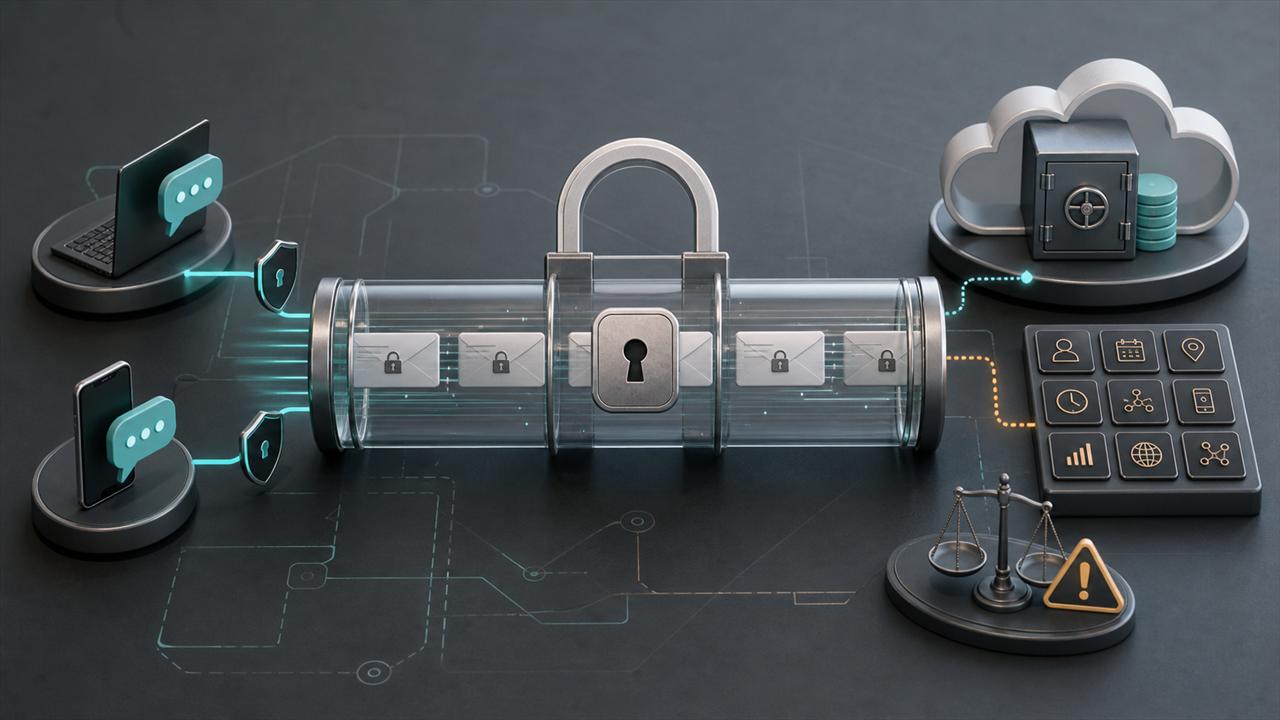
On May 21, 2026, the Texas Attorney General filed a consumer-protection lawsuit against Meta Platforms and WhatsApp. The complaint alleges that WhatsApp misleads users by promising that personal messages are protected by end-to-end encryption while, according to Texas, Meta and WhatsApp can access communications more broadly than users are led to believe. Those are allegations, not court findings.
The technical issue is more useful than the headline. End-to-end encryption can be true for one category of communication while exceptions, endpoint behavior, reports, backups, business chats, AI integrations, metadata, and account recovery still create meaningful privacy exposure. Readers should separate what WhatsApp's cryptography is designed to protect from what the product, policy, and legal claims leave outside that protection.
Key Takeaways
- check_circle Treat the Texas filing as an allegation and a marketing-claims dispute, not as proof that WhatsApp's Signal Protocol encryption is broken.
- check_circle WhatsApp's own technical white paper says personal messages and calls between user-controlled devices use the Signal Protocol and are designed to prevent plaintext access by WhatsApp or Meta.
- check_circle The same white paper and privacy policy describe important boundaries around Cloud API business chats, Meta services, reports, customer support, backups, metadata, and device information.
- check_circle Users who need strong privacy should check encrypted backup settings, linked devices, business-chat labels, report behavior, and whether AI or automated accounts are part of a chat.
- check_circle Organizations should avoid blanket privacy claims and document which message categories, logs, backups, support flows, and vendor-operated endpoints are inside or outside end-to-end protection.
What Texas Filed
The Texas Attorney General's May 21 press release says the state filed suit under the Texas Deceptive Trade Practices Act. The public petition names Meta Platforms and WhatsApp as defendants and alleges that WhatsApp's privacy marketing deceives consumers by overstating the strength and scope of its protections.
The petition focuses on the promise that personal messages, photos, calls, and related communications stay between the sender and the chosen recipients. It alleges that Meta and WhatsApp have access to communications despite public statements that not even WhatsApp can see them. The filing cites WhatsApp marketing, privacy pages, app-store representations, congressional testimony, public reporting, and alleged access by employees or contractors.
Those claims have not been tested in court. The petition is a plaintiff's framing of the dispute, not a judicial finding about WhatsApp's cryptographic implementation. For technical readers, the right starting point is therefore narrow: compare the public marketing claim with WhatsApp's own architecture documents, privacy policy, and listed exceptions.
What WhatsApp Publicly Claims
WhatsApp's public privacy page says personal messages, photos, calls, and other content are protected with end-to-end encryption so they stay between the user and the people the user chooses. Its technical white paper, updated February 25, 2026, gives the more precise version: WhatsApp messages, voice calls, and video calls between sender and receiver devices running WhatsApp client software use the Signal Protocol.
The white paper defines end-to-end encryption as communications encrypted from a device controlled by the sender to one controlled by the recipient, where no third parties, including WhatsApp or Meta, can access the content in between. It also says the Signal Protocol is designed so that even if current encryption keys from one device are physically compromised, they cannot decrypt previously transmitted messages.
That is the part of the system most people mean when they say WhatsApp is end-to-end encrypted. It is also the part that should not be casually dismissed without evidence. A lawsuit about consumer representations can be important even if the underlying message protocol still does what the public technical paper says it does for ordinary personal chats.
The Technical Boundary
End-to-end encryption protects content between endpoints. It does not make endpoints trustworthy, prevent a recipient from exporting content, hide every piece of metadata from the service, encrypt all backups by default in every configuration, or make business and AI workflows identical to personal chats.
WhatsApp's privacy policy says delivered messages are not retained in the ordinary course of providing the service and are stored on user devices. It also says undelivered messages may be held in encrypted form for up to 30 days, forwarded media may be stored temporarily in encrypted form for efficient delivery, and users or businesses can share messages outside the service.
The same policy describes categories of automatically collected information, including service-related, diagnostic, performance, activity, device, connection, IP address, and interaction information. That metadata can matter even when message content remains encrypted. For activists, journalists, finance teams, executives, or regulated organizations, metadata exposure and content exposure are different risks, but both belong in the privacy model.
Where Content Can Leave The Tunnel
The most important distinction is personal user chats versus special product flows. WhatsApp's white paper says communications with Meta services and communications with businesses using Cloud API are not considered end-to-end encrypted. It also says one-to-one chats with businesses that link Cloud API are not considered end-to-end encrypted because messages and calls are shared by the business to Meta for processing on behalf of the business.
The paper also describes automated chat invocation messages. It says personal messages in individual or group chats that do not contain an automated chat account remain end-to-end encrypted, while an invocation message sends a copy of that message to an automated chat account under a separate design. That is a product boundary users need to understand, especially as AI features become harder to avoid in messaging apps.
Reports and support are another category. WhatsApp's policy says customer support communications may include copies of messages that the user provides. It also says users and third parties can report interactions and messages to WhatsApp. That is not the same as the company passively reading every ordinary personal message, but it is a real pathway by which selected message content can be sent to the service.
Backups Are A Separate Decision
Cloud backups are a frequent source of privacy confusion because they sit outside the normal chat transport path. WhatsApp advertises end-to-end encrypted backups as an optional privacy layer for messages saved to iCloud or Google Drive. Its privacy policy also warns that when users rely on an integrated third-party backup service, that service receives the information the user shares with it, such as WhatsApp messages.
The practical advice is simple: verify backup status instead of assuming it. If encrypted backups are off, the user's backup provider and account-security choices become part of the threat model. If encrypted backups are on, recovery material must be protected, because losing the password or key can make backup recovery impossible.
For organizations, backups are not a user-education footnote. They are a data-governance decision. A company that discusses sensitive matters over consumer messaging tools should decide whether backups are allowed, whether managed devices are required, how legal hold works, and whether business communications belong on a platform where personal account recovery settings can change the risk.
What The Case Does Not Prove
The Texas lawsuit does not by itself prove that WhatsApp can decrypt every personal chat, that the Signal Protocol is broken, that every employee can browse messages, or that every marketing statement is unlawful. Those questions require evidence, definitions, discovery, and court findings.
It also does not remove the need for careful language from WhatsApp and other secure messaging providers. A short marketing line can be technically true for ordinary personal chats while still leaving users unclear about business endpoints, AI accounts, reports, support copies, linked devices, backups, and metadata. When a product has billions of users, those distinctions need to be visible before a user chooses a risky flow.
The fair reading today is therefore restrained. Texas has filed a serious consumer-protection claim. WhatsApp's public documents describe both a strong end-to-end encryption design for ordinary personal communications and several cases outside that design. The dispute will turn on what was represented, what was disclosed, what access actually existed, and how a reasonable user would understand the promise.
Practical Checks For Users And Teams
Users should open their backup settings and confirm whether end-to-end encrypted backups are enabled. They should also review linked devices, use security-code verification for high-risk contacts, be careful when messaging business accounts, and understand that reporting a user or asking support for help may send selected content to WhatsApp.
Teams should document what belongs on WhatsApp and what does not. If the conversation involves regulated data, incident response, privileged credentials, merger planning, unreleased financials, source code, or legal strategy, a consumer messenger may be the wrong surface even when ordinary chats are end-to-end encrypted. The right tool is the one whose encryption, retention, admin controls, exports, legal hold, and support access match the job.
Vendors should learn the same lesson from the other side. Do not market end-to-end encryption as a single magic property if the product has exceptions. Publish a plain matrix that separates personal chats, business chats, AI or automated accounts, group features, backups, reports, support, metadata, law-enforcement responses, and account recovery. The more precise the claim, the less room there is for confusion or overreach.
Checklist
- Confirm whether end-to-end encrypted backups are enabled and store recovery material safely.
- Review linked devices and remove any device that should no longer receive messages.
- Check business-chat labels and avoid sending sensitive material to business or automated accounts unless the privacy state is clear.
- Understand that reports, support requests, screenshots, exports, and recipient behavior can move content outside the encrypted channel.
- Treat metadata, device information, contact data, and interaction logs as separate privacy risks from message content.
- For organizations, write a messaging policy that maps each communication category to approved tools and retention rules.
Sources
- Texas Attorney General press release on WhatsApp lawsuit open_in_new
- Texas v. Meta Platforms and WhatsApp original petition open_in_new
- WhatsApp Privacy page open_in_new
- WhatsApp Privacy Policy open_in_new
- WhatsApp Encryption Overview technical white paper open_in_new
- Signal: WhatsApp Signal Protocol integration is complete open_in_new
- Meta Engineering: Building Private Processing for AI tools on WhatsApp open_in_new
Continue Reading

Google Workspace DBSC Makes Stolen Cookies Less Portable
Google made Device Bound Session Credentials generally available for Workspace users in Chrome on Windows. The useful change is narrower than passwordless login: it targets session theft after authentication.
GitHub's GHES Signing-Key Rotation Is a Supply-Chain Warning
GitHub's May 2026 Enterprise Server signing-key rotation shows how a poisoned developer tool can force enterprise software verification, release, and secret-rotation decisions.
Kali365 Turns Microsoft 365 MFA Into a Token Problem
The FBI's May 2026 Kali365 alert shows why Microsoft 365 teams need to treat device-code OAuth flows, refresh tokens, and session revocation as first-class controls.