DKVE Makes Key Verification A Social-Graph Problem
A new DKVE paper proposes privacy-preserving mutual-contact checks for encrypted messaging keys. The practical question is how much trust should move from manual safety numbers to automated validation.
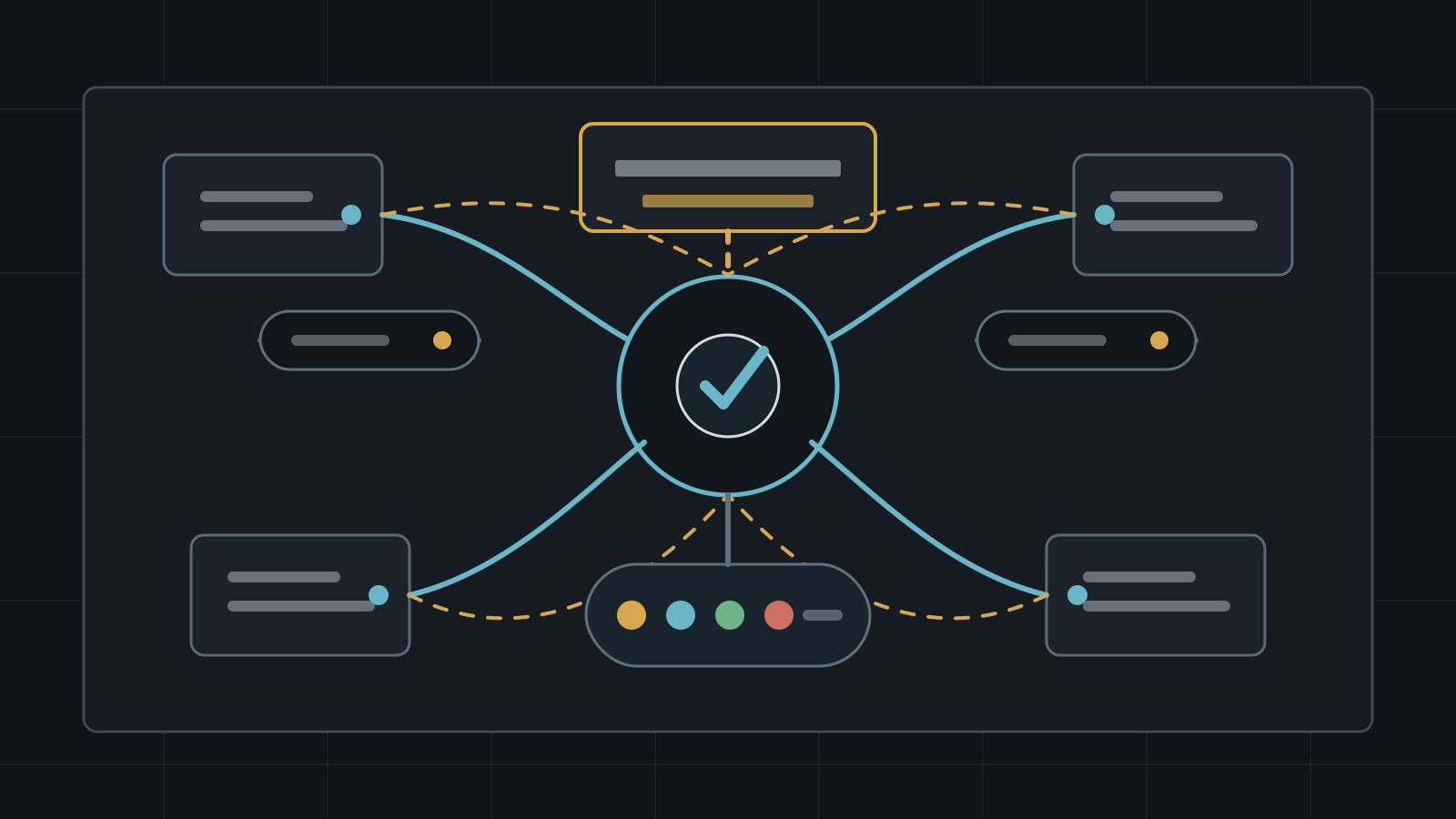
End-to-end encrypted messaging depends on one fragile step before the first message is sent: the app has to give each participant the right public keys. A malicious, compromised, or pressured key server can try to substitute a fake key and turn strong encryption into a man-in-the-middle path. Safety numbers and QR codes can catch that, but only when users actually verify them.
A June 25, 2026 paper called DKVE proposes a different way to reduce that burden. Instead of asking every user to compare codes, it uses privacy-preserving checks through mutual contacts to test whether other clients see the same public key for a person. The idea is promising, but it is not a replacement for key transparency, out-of-band verification, or careful product design.
Key Takeaways
- check_circle Public key distribution is part of the encrypted messaging trust boundary, not a background account service.
- check_circle Manual safety numbers provide strong verification when used correctly, but real users often skip them or misunderstand key-change warnings.
- check_circle DKVE proposes background validation through mutual contacts while using cryptographic tools to limit exposure of contact lists and queries.
- check_circle The paper reports strong detection rates for strong-to-moderate social ties, but weak-tie networks, new accounts, and sparse communities remain hard cases.
- check_circle Automated validation should be treated as a layered signal, not a single yes-or-no proof that a conversation is safe.
- check_circle Community operators should ask messaging vendors how key changes, new devices, verification failures, and manual fallbacks are surfaced to users.
What DKVE Claims
The DKVE paper, submitted to arXiv on June 25, frames the problem clearly: encrypted messaging needs authentic public key distribution, while the two common approaches each have costs. Out-of-band verification can be strong, but it requires users to coordinate and compare values. Key transparency can automate consistency checks, but large append-only directories bring storage, latency, privacy, and operational complexity.
DKVE stands for decentralized key validation. The proposal validates a contact's public key by asking mutual contacts whether they hold the same binding. The paper says it combines oblivious pseudorandom functions and oblivious key-value stores to preserve privacy around queries and contact lists, then uses a sequential probability ratio test to aggregate responses. In simulations on real social network datasets, the authors report detection above 97 percent for strong-to-moderate-tie networks. That is a research result, not a production guarantee, but it is substantial enough to matter for secure messaging design.
Why Keys Are A Server Boundary
End-to-end encryption prevents a passive server from reading message content when endpoints already have the right keys. It does not automatically solve the question of who handed those keys to the endpoints. Most mainstream messengers rely on a service to publish or retrieve key material for a user or device. If that service gives Alice a key controlled by an attacker while claiming it belongs to Bob, Alice may encrypt to the wrong endpoint.
This is why Signal has safety numbers and WhatsApp has security code verification. The user compares a value shown on both devices, usually by scanning a QR code or comparing digits through a separate channel. When the values match, the participants have evidence that the app is using the same key material. The security problem is human adoption. Verification is easy to recommend and hard to make routine across large groups, rotating devices, public communities, and low-context contacts.
What Key Transparency Adds
Key transparency moves part of the work into an auditable directory. WhatsApp's key transparency deployment uses an auditable key directory and a public audit record so clients can check whether account-to-key mappings are consistent over time. Meta's engineering write-up says the goal is to make verification automatic while preserving the option for manual security-code comparison.
The model follows earlier academic work such as CONIKS, which proposed a way for users and providers to audit key bindings without exposing a global username list. The value is consistency. A provider should not be able to show one public key for a target to Alice and a different key to everyone else without creating evidence that can be audited. The cost is infrastructure: append-only records, proof generation, public auditing, client checks, and privacy protection around the directory itself.
Where The Proposal Is Useful
The strongest product value is silent background evidence. A normal user should not need to understand Merkle trees, safety numbers, or probability tests to benefit from key consistency checks. If an app can cheaply ask trusted parts of the social graph whether a key looks consistent, then manual verification can be reserved for higher-risk events: a warning, a new device, an admin account, a journalist-source conversation, or a sensitive community room.
The proposal also gives operators another way to think about scale. DKVE does not claim to remove key transparency. It claims that social-graph validation can reduce how often clients need to query heavier transparency systems. That matters because billion-user key directories accumulate enormous histories as people reinstall apps, change phones, add companion devices, and delete accounts. If the design survives review, it could become a complementary signal that lowers load while keeping manual and public-audit paths available.
Where It Can Fail
The paper is explicit that DKVE does not solve every case. Bootstrapping is difficult because a new user may not have enough mutual contacts. Weak-tie networks reduce detection confidence. A high-risk user may intentionally keep contacts compartmentalized, which is good operational security but bad for social-graph evidence. A hostile community could have many attacker-controlled mutual contacts. Any design that depends on relationship structure has to handle the cases where relationship structure is sparse, sensitive, or actively manipulated.
There is also a product risk: automated checks can create false confidence. A green indicator that hides weak evidence may be worse than no indicator at all. A failed check must not leak sensitive relationship data through support logs, analytics, or notification text. Vendors also need to decide what happens when the network is offline, a device is stale, mutual contacts have not synced recently, or a user has multiple active devices with different verification states.
What To Ask Messaging Vendors
A serious vendor should be able to separate cryptographic protocol claims from key-distribution claims. Ask how new device keys are published, how old keys are retired, how key changes appear to users, whether safety-number or security-code verification exists, and whether the app has any automated consistency check. If the answer is key transparency, ask who audits the log, how clients verify proofs, what metadata is exposed, and what happens when proofs fail.
If a vendor points to DKVE or a similar social-graph method, ask whether it is deployed or only on a roadmap. Ask what privacy protections prevent contact-list leakage, what evidence threshold triggers a warning, how weak-tie accounts are handled, and what manual fallback remains. The practical standard is layered verification: automatic checks for routine use, visible warnings for key changes, manual verification for high-trust conversations, and clear behavior when the system cannot gather enough evidence.
Checklist
- Identify how the messenger distributes public keys for each account and linked device.
- Verify whether users can compare safety numbers, security codes, or QR codes outside the app.
- Ask whether automated key consistency checks are based on key transparency, social-graph validation, or both.
- Check how key-change warnings behave for reinstallations, new phones, companion devices, and group membership changes.
- Confirm that verification failures do not leak contact relationships through logs, analytics, or notifications.
- Reserve manual verification for admins, journalists, moderators, high-risk users, and sensitive rooms.
Sources
- arXiv: DKVE: Decentralized Key Validation for End-to-End Encrypted Messaging open_in_new
- Meta Engineering: Deploying key transparency at WhatsApp open_in_new
- USENIX Security 2015: CONIKS: Bringing Key Transparency to End Users open_in_new
- arXiv: Automatic Detection of Fake Key Attacks in Secure Messaging open_in_new
- Signal: Safety number updates open_in_new
Continue Reading
Chat Attachments Turn Encryption Into Storage Policy
Files, images, voice notes, and previews often leave a different security trail than message text. Review chat attachments as storage, scanning, export, and retention infrastructure.
DNS Leaks Turn VPN Privacy Into Resolver Policy
A VPN can hide traffic while DNS queries still identify where a device is going. Resolver choice, browser DoH, mobile private DNS, and leak testing belong in the VPN policy.
MLS Makes Group Chat Security A Protocol Integration Problem
Messaging Layer Security standardizes group key agreement, but delivery services, identity, access control, ordering, and backups still decide whether a secure room behaves safely.