Post-Quantum Messaging Needs More Than New Keys
Quantum-safe messaging is not a single algorithm swap. Teams need to understand hybrid key agreement, ratchets, group behavior, backups, identity keys, and migration transparency.
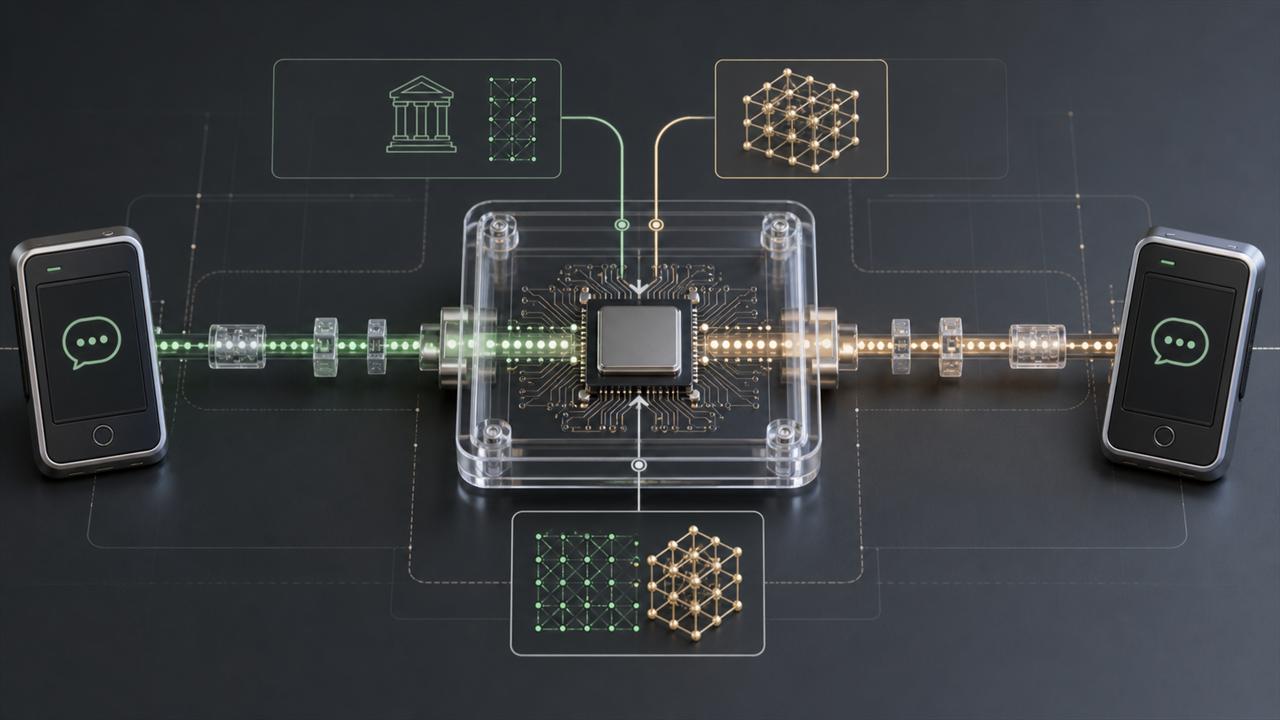
Post-quantum messaging is a migration problem, not a headline feature. NIST has finalized the first post-quantum standards, CISA has told organizations to build cryptographic inventories and roadmaps, and large messaging systems have started adding post-quantum components to real protocols. The direction is clear even though most threat models do not require panic.
The useful question is not whether a chat app can say quantum-safe. It is where post-quantum cryptography sits in the protocol, whether classical and post-quantum secrets are combined safely, how ongoing ratchets recover after compromise, how group chats and attachments behave, and how users can verify that old and new clients are on the intended path.
Key Takeaways
- check_circle Harvest-now-decrypt-later risk is the main reason messaging products should care before a cryptographically relevant quantum computer exists.
- check_circle NIST's ML-KEM standard gives implementers a stable post-quantum key-establishment building block, but protocol integration still needs expert review.
- check_circle Hybrid designs are prudent because they combine classical assumptions with post-quantum assumptions during the migration period.
- check_circle One-time post-quantum session setup is weaker than a design that also updates post-quantum material during the conversation.
- check_circle Product teams need transparency about which conversations, clients, backups, attachments, and group states are actually covered.
The Threat Is Long-Lived Confidentiality
A practical quantum computer capable of breaking widely deployed public-key cryptography is not something defenders can schedule into a normal quarterly roadmap. The risk for messaging is different: an adversary can collect encrypted traffic now and try to decrypt it later if the public-key assumptions behind the original key exchange fail.
That matters most for conversations whose confidentiality has a long shelf life. Political organizing, legal work, source protection, vulnerability coordination, crypto custody, dissident communication, private health discussions, and sensitive business negotiations may remain valuable years after they happen. If those sessions were established only with quantum-vulnerable public-key cryptography, future decryption could expose today's traffic.
Symmetric encryption is not the same problem. Current guidance generally treats the public-key side of encryption, key establishment, and signatures as the urgent migration area. Messaging protocols therefore need to focus on how session keys are established, refreshed, authenticated, and replaced as clients and servers move through a long mixed-version period.
Standards Changed The Planning Baseline
NIST's first finalized post-quantum standards changed the planning conversation. FIPS 203 standardizes ML-KEM for key encapsulation, while FIPS 204 and FIPS 205 cover post-quantum digital signature schemes. That does not mean every product should improvise a protocol immediately. It means vendors no longer have the same excuse for doing no inventory, no tests, and no migration plan.
CISA, NSA, and NIST guidance is deliberately operational. It tells organizations to build a quantum-readiness roadmap, identify where cryptography is used, understand dependencies, and engage vendors. For messaging products, that inventory includes more than TLS at the edge. It includes account identity keys, device keys, prekeys, group sender keys, backup encryption, media attachment encryption, contact discovery paths, and update signing.
The planning baseline is therefore broader than the chat transcript. A product can add post-quantum key agreement to message sessions while still relying on quantum-vulnerable signatures for software updates or device identity. That may still be progress, but it should be described precisely.
Messaging Is Harder Than TLS
TLS migration is not easy, but a messaging system has extra state. People go offline, add devices, rotate phones, join and leave groups, link desktop clients, send queued messages, and expect old conversations to keep working. A protocol that looks clean for two online devices may behave differently when one participant is offline for weeks.
Signal's PQXDH work illustrates the first major integration pattern: combine classical X25519 with a post-quantum key encapsulation mechanism during session establishment. The point of a hybrid design is that the resulting secret should remain protected if either the classical or post-quantum assumption holds. That is a cautious migration posture because new post-quantum algorithms and implementations still need field experience.
Apple's PQ3 design shows a different messaging concern: initial establishment is not enough. Apple described post-quantum material in registration keys and ongoing rekeying so a conversation can regain strong security after a key is compromised. Signal's later Sparse Post Quantum Ratchet work points in the same direction: long-lived conversations need post-quantum thinking beyond the first handshake.
Hybrid Designs Need Clear Claims
Hybrid cryptography can be misunderstood by users and marketers. It should not be described as a guarantee that no future attack is possible. It is a conservative engineering pattern: combine secrets from a mature classical primitive and a post-quantum primitive so the session is not resting on one untested assumption.
The details matter. Key derivation has to combine inputs correctly. Client negotiation has to avoid downgrade problems. Old clients need a supported behavior that does not silently remove protection for everyone. Error handling must not leak secrets or create denial-of-service paths. Implementations need constant-time behavior, careful parsing, and dependency updates.
The source of the post-quantum primitive also matters. NIST standardization gives implementers a stable reference point for ML-KEM, but it does not validate every application protocol. A messaging vendor still needs external review, test vectors, rollout telemetry, and clear documentation of what is covered.
Groups, Backups, And Attachments Matter
One-to-one text messaging is the easiest place to explain post-quantum migration. Real products are messier. Group messaging may use group state, sender keys, membership epochs, device lists, and asynchronous delivery. A single outdated device can affect the security claim for the group if the product does not define downgrade and rekey behavior clearly.
Backups are another common gap. A message protected by a post-quantum session can later be stored in a cloud backup protected by a different key-management model. If that backup is recoverable through weaker account recovery, the session protocol did not preserve end-to-end confidentiality in the way users may assume.
Attachments and previews deserve the same scrutiny. Media may be encrypted with separate keys, stored in different services, cached by clients, scanned before upload, or included in link previews. A product that makes a post-quantum claim should say whether it covers only message-body key establishment or the broader set of content flows.
Adoption Questions For Product Teams
A practical evaluation starts with scope. Which protocol versions are post-quantum aware? Which platforms have shipped them? Are linked desktop clients covered? Are new group sessions covered by default? What happens when one participant uses an old client? Can users or administrators see a meaningful status, or is the migration invisible?
The second question is identity. Post-quantum key agreement protects the confidentiality of a session secret, but authentication often still relies on identity keys, certificates, transparency systems, or update channels. If signatures remain classical, that may be an acceptable staged migration, but the claim should be limited.
The final question is accountability. Serious vendors should publish protocol descriptions, external review notes where possible, implementation details, and migration timelines. Protocol Report readers should reward restrained claims: a vendor that says exactly which surfaces are protected is more credible than one that turns quantum into a badge.
Checklist
- Inventory every cryptographic dependency in the messaging product, not only the transport layer.
- Identify which conversations need long-lived confidentiality against harvest-now-decrypt-later collection.
- Prefer reviewed hybrid designs during migration instead of replacing classical primitives in isolation.
- Check whether post-quantum protection applies to session setup, ongoing ratchets, groups, attachments, and backups.
- Define old-client and downgrade behavior before rollout.
- Ask vendors for protocol documentation, external review, implementation status, and client coverage.
- Keep claims specific: say which keys, content paths, and product surfaces are post-quantum protected.
Sources
- NIST: First finalized post-quantum encryption standards open_in_new
- NIST FIPS 203: ML-KEM open_in_new
- NIST FIPS 204: ML-DSA open_in_new
- CISA: Quantum-Readiness migration to post-quantum cryptography open_in_new
- CISA: Post-Quantum Cryptography Initiative open_in_new
- Signal: Quantum Resistance and the Signal Protocol open_in_new
- Signal: Signal Protocol and Post-Quantum Ratchets open_in_new
- Apple Security Research: iMessage with PQ3 open_in_new
Continue Reading
Storm-2949 Turns Password Reset Into Cloud Breach
Microsoft's Storm-2949 report shows how self-service password reset abuse can become cloud-wide access across Key Vault, web apps, SQL, storage, VMs, and MFA registration.
Passkeys Move Account Risk To Recovery
Passkeys remove the reusable password from login, but the hard security work moves to recovery, sync, device binding, fallback methods, and privileged account policy.
Discord E2EE Calls Raise The Privacy Baseline
Discord says every voice and video call outside Stage channels now uses end-to-end encryption by default. The practical result is stronger media confidentiality, with clear limits around text, metadata, verification, previews, and device compromise.