Presence And Read Receipts Are Chat Metadata
Typing indicators, read receipts, last-seen status, and presence APIs can reveal behavior without exposing message content. Treat chat metadata as a product and policy decision.
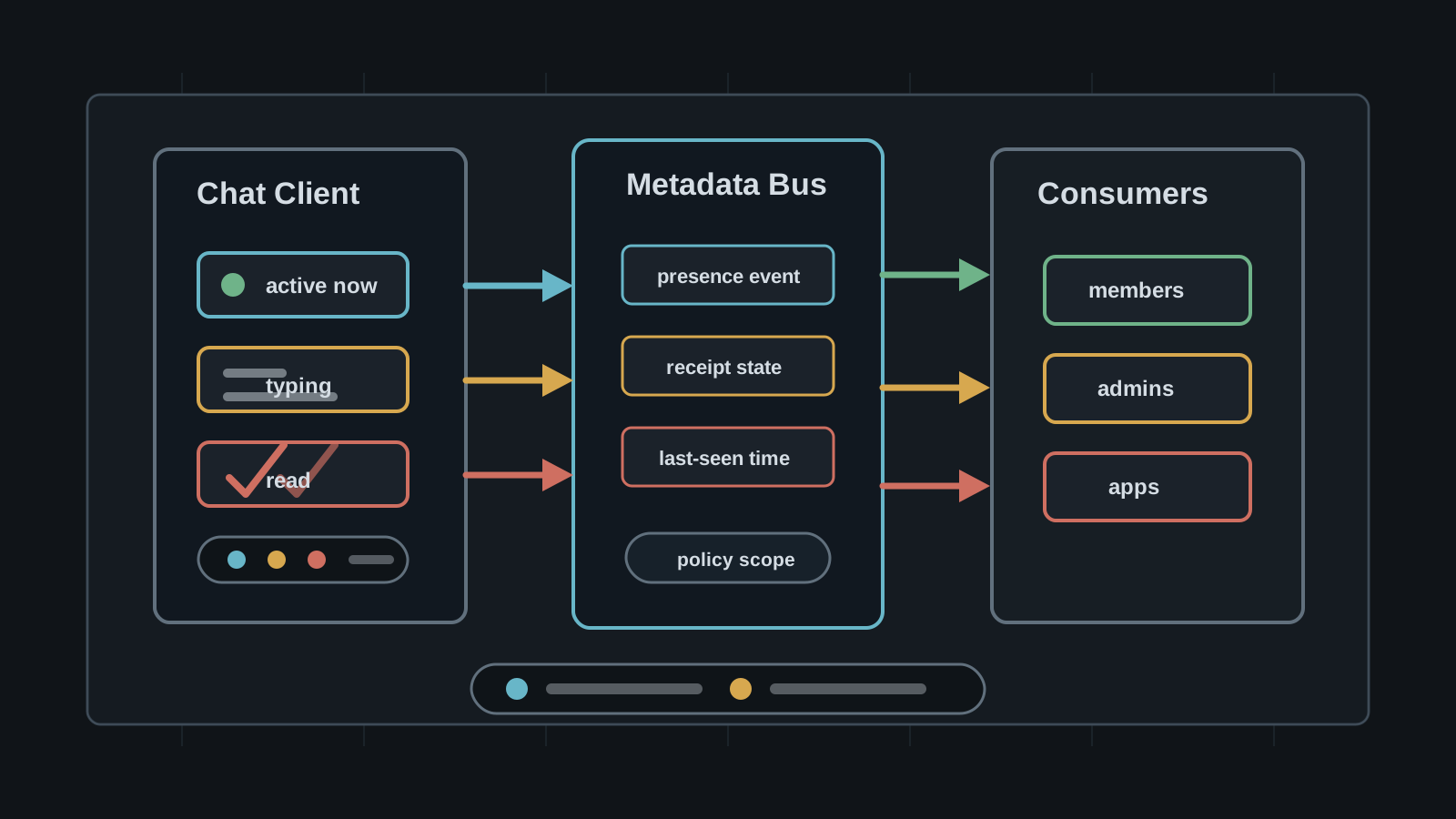
End-to-end encryption protects message content, but it does not automatically hide the behavioral signals around a conversation. Typing indicators, read receipts, delivered markers, last-seen status, custom presence, active or away state, notification counts, and API-accessible status fields can reveal when a person is awake, reachable, avoiding a thread, working late, or coordinating with a group.
That does not make every indicator unsafe. Many teams rely on presence to reduce interruption and many users like read receipts in trusted groups. The practical question is whether the product treats those indicators as metadata with scope, controls, retention, and abuse cases, or as harmless interface polish.
Key Takeaways
- check_circle Presence is metadata because it describes user behavior even when message bodies remain encrypted.
- check_circle Read receipts and typing indicators should be reviewed separately from message encryption claims.
- check_circle Workspace APIs can turn a status light into a machine-readable data feed for apps, bots, and monitoring tools.
- check_circle Defaults should match the room's threat model: private support groups, activist teams, executives, and public communities do not need the same exposure.
- check_circle Privacy controls need to cover groups as well as direct messages because group receipts can reveal attention patterns at scale.
- check_circle A credible chat privacy review asks who can see, query, export, retain, and correlate presence signals.
Why Presence Is Metadata
Presence signals are small, but they are not empty. An active marker says a client is connected or recently used. A last-seen value says when a user was reachable. A read receipt says a person opened a conversation up to a specific point. A typing indicator says a user started composing, even if no message was sent. Over time, those signals form a behavioral map.
The risk depends on context. In a small internal engineering workspace, presence may be an ordinary coordination tool. In a survivor support group, labor organizing channel, newsroom tip line, executive incident room, or high-risk political network, the same signals can expose availability, relationships, time zones, attention, and stress.
Read Receipts And Typing Signals
The Matrix Client-Server API makes the distinction clear. It defines typing notifications as ephemeral room events that list the user IDs currently typing. It also defines read receipts, including a public read receipt and a private read receipt that clears notification state without broadcasting the user's read position to other users. That is a useful design lesson: a client can need local read state without turning that state into shared social telemetry.
Telegram's FAQ shows the product-level version of the same issue. Its check marks distinguish delivery to Telegram's cloud from a message being read, and its last-seen controls replace hidden precise timestamps with approximate values. Those choices acknowledge that status can be useful while still needing ambiguity and user control.
APIs Turn Interface Signals Into Data Feeds
Presence becomes a different security problem when it is exposed through APIs. Slack's presence documentation describes custom status as profile data and its users.getPresence method can return active or away state. For the authenticated user, the response can also include whether a client is online, manual or automatic away state, connection count, and last activity seen by Slack servers.
That API surface is useful for workflows, directories, incident response rotations, and scheduling tools. It is also a reason to treat status data as access-controlled information. Once an app can query presence, the review expands from the user interface to OAuth scopes, bot membership, logs, third-party processors, retention, and what happens when an app is removed.
Encryption Does Not Settle Metadata
Signal's sealed-sender work is a useful reference point because it separates content secrecy from service-visible metadata. Signal said the service is designed to minimize retained user data and described sealed sender as an incremental step toward hiding who is messaging whom. The same post also notes that traffic correlation through timing and IP addresses remained an area for ongoing work.
The broader lesson is simple: encryption claims need boundaries. Message bodies, sender identity, recipient identity, device IPs, delivery timing, read state, online status, and typing state are different pieces of data. A product can protect one strongly while exposing another for usability, abuse prevention, federation, delivery, or enterprise governance.
Defaults Need A Threat Model
The right default is not universal. Consumer chat often rewards immediacy. Workspace chat often rewards coordination. Private communities often need a quieter posture. Some rooms should have no typing indicators, no public read receipts, no precise last-seen state, and limited presence access for bots. Other rooms may accept those signals because the collaboration value is higher than the exposure.
Administrators should avoid treating this as a personal preference only. In a community, one user's presence setting can reveal group behavior. In a workspace, a bot with user-read scope can observe many people. In a federated or bridged room, one system's privacy setting may not survive the trip into another product. Defaults need to match the riskiest expected use, not the lowest-friction demo.
How To Review The Surface
Start with an inventory. List every presence-like signal the product emits: online state, last active, custom status, typing, delivery, read receipts, thread read state, voice-room activity, profile changes, and mobile push state. For each signal, document who can see it, whether users can disable it, whether admins can force it, whether apps can query it, and whether it appears in exports or logs.
Then test abuse cases. Can a low-trust member track moderator availability? Can an app build a work schedule from active state? Can group read receipts reveal who saw a sensitive report? Can bridges or bots replay typing and receipt events into another platform? If the answer is yes, the product needs clearer controls, narrower scopes, shorter retention, or safer defaults for sensitive rooms.
Checklist
- Inventory online state, last-seen values, typing indicators, delivery markers, read receipts, and custom status fields.
- Confirm whether each signal is visible in direct messages, group rooms, public channels, external rooms, bridges, and exports.
- Review app and bot scopes that can read profile, status, presence, user lists, or room events.
- Disable or narrow public read receipts and typing indicators in high-risk rooms.
- Prefer approximate or private read state where exact attention timing is not needed.
- Document which presence settings are user-controlled, admin-controlled, or fixed by the platform.
Sources
- Matrix Client-Server API: typing notifications and receipts open_in_new
- Signal: Technology preview, sealed sender open_in_new
- Slack Developer Docs: user presence and status open_in_new
- Slack Developer Docs: users.getPresence open_in_new
- Telegram FAQ: check marks, last seen, and online status open_in_new
- RFC 6973: Privacy Considerations for Internet Protocols open_in_new
Continue Reading

MFA Push Prompts Are Not Identity Proof
Push approvals can stop password-only compromise, but fatigue, phishing proxies, and weak recovery make them a consent surface. Treat prompts, number matching, and phishing-resistant MFA as admin policy.
Rate Limits Are Community Bot Security Controls
Discord, Slack, Telegram, and GitHub rate limits are not just reliability plumbing. Bot owners should treat quotas, 429 handling, queues, and invalid-request limits as blast-radius controls.
Moderation Logs Are Community Security Data
Bans, message removals, AutoMod hits, role changes, and reports are evidence and sensitive records. Community teams need log access, retention, and export policy.