Token-Gated Discord Starts With Signature Risk
Token-gated communities often ask members to connect wallets, sign messages, and receive Discord roles. The danger is not only asset approval; it is session, domain, and role integrity.
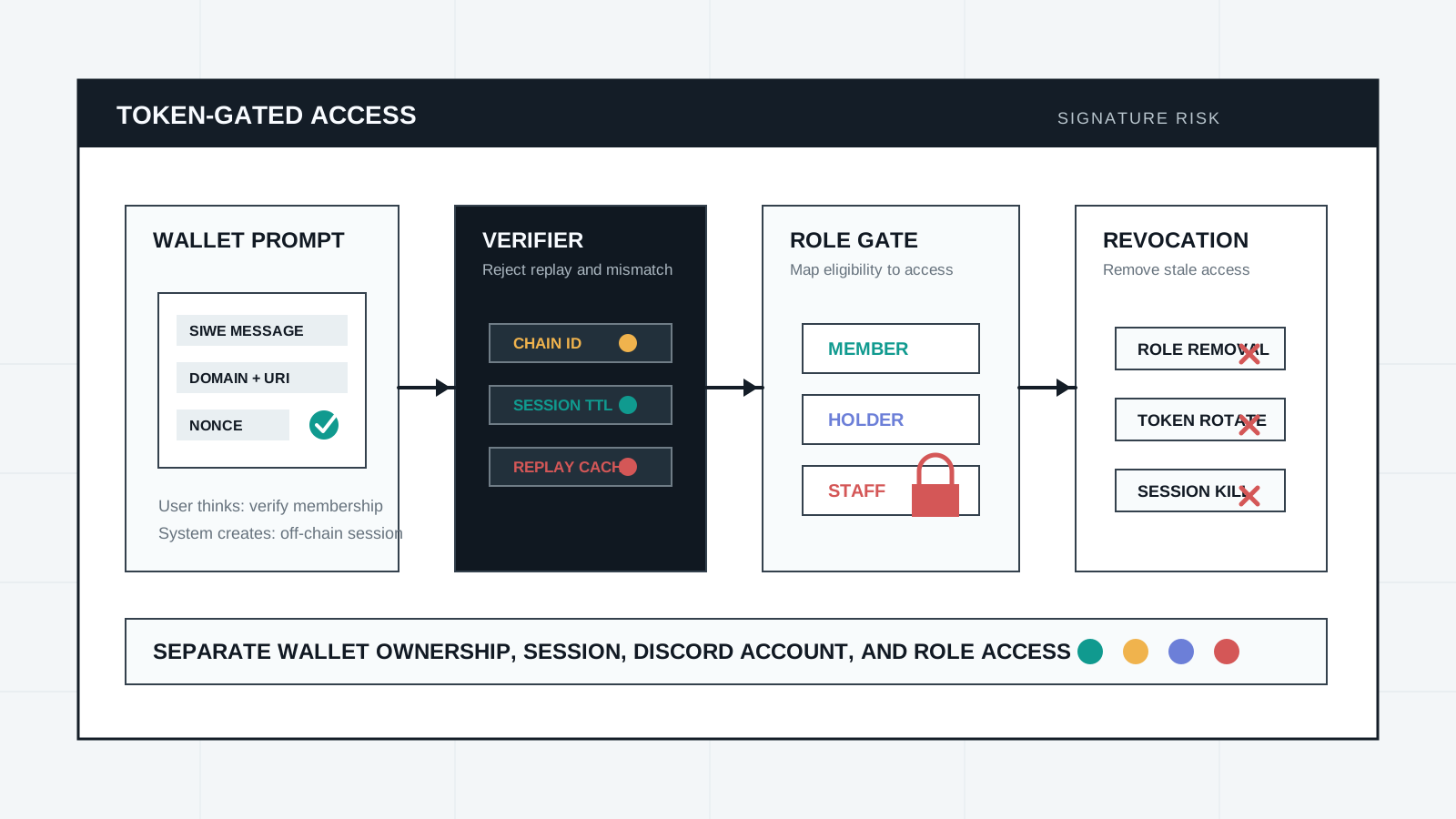
Token-gated Discord servers and private communities sit at the intersection of wallet authentication, OAuth, bot permissions, role assignment, and social trust. A member may think they are only proving ownership of an NFT, token, or wallet address. In reality, the gate is creating an off-chain session and often changing what that person can see or do inside a community.
The security work is therefore broader than avoiding malicious token approvals. A login message can be phished. A signature can be replayed if the relying party gets nonce and origin checks wrong. A WalletConnect session can expose methods the user did not expect. A Discord bot can assign roles too broadly or keep stale access after a token is sold. Token gates are identity systems, and they need the same design discipline as other privileged authentication flows.
Key Takeaways
- check_circle Off-chain wallet signatures are authentication events; they should not be treated as harmless proof prompts.
- check_circle Sign-In with Ethereum gives relying parties a structured message format with domain, URI, chain ID, nonce, issue time, and optional expiry fields.
- check_circle Wallets and dapps need origin and domain checks because lookalike gates can steal signatures without moving tokens on-chain.
- check_circle Discord role gates should be narrow, time-bound, logged, and revocable when wallet ownership or eligibility changes.
- check_circle A token gate should separate wallet ownership, community identity, Discord account linkage, bot authority, and channel access.
- check_circle Incident response must include session invalidation, role removal, bot-token rotation, and review of stale entitlements.
Why Token Gates Are Identity Systems
A token gate is usually described as a membership convenience: connect a wallet, prove ownership, get access to a private channel. That framing hides the more important security fact. The gate binds an on-chain address to an off-chain account and then lets automation change a community permission. If the binding is wrong, stale, or phished, the community has an identity failure.
The user experience also creates risk. People have been trained to click through wallet prompts to join a server, claim a role, enter a mint, vote, or verify membership. Some prompts spend assets or grant token allowances. Others only sign a message. The second category can still be dangerous because the signature may establish a web session, authorize a capability, or prove control of an address to an attacker-controlled service.
SIWE Is Safer Than Ad Hoc Signing
ERC-4361, better known as Sign-In with Ethereum, exists because ad hoc wallet login messages were hard for users and relying parties to reason about. The standard defines a plaintext message format for off-chain authentication. It includes fields such as domain, address, URI, version, chain ID, nonce, issued-at time, optional expiration time, optional not-before time, request ID, and resources.
Those fields matter. The domain and URI help bind the signature to the site that requested it. The nonce helps prevent replay. The chain ID gives context for contract-account verification. Expiration and not-before fields limit the period in which a signed message should be accepted. Without those elements, a community may accept a signature that was captured for another site, another chain, or another time.
WalletConnect Sessions Need Domain Review
WalletConnect and similar wallet-session systems add another layer. A session proposal can ask for chains, methods, events, and accounts. A signing request can arrive after the first connection. WalletConnect's Verify API documentation frames domain risk directly: wallets can show whether a domain is verified, unverified, mismatched, or flagged as a threat. It also warns that the system is not bulletproof and is intended to make impersonation harder.
For token-gated communities, that means the gate should not rely on a generic connect button and a hopeful user. The flow should display the expected domain, wallet address, chain, signing method, requested session permissions, and the action being authorized. If the gate uses WalletConnect One-click Auth or ReCap-style capability messages, the capability text needs to be human-readable and limited to the operation the user is actually approving.
Discord Roles Are The Operational Boundary
Discord's API documentation makes clear that OAuth scopes, bot users, application role connections, and permissions are distinct pieces. A token gate that uses Discord roles is not finished when wallet ownership is verified. It still needs a bot or application with the right scope to write role-connection metadata or adjust server state, and that bot's permissions determine the blast radius if the gate is compromised.
Role design should be conservative. A proof of token ownership should grant only the rooms and actions that membership requires. It should not place the user near moderator capabilities, private staff channels, billing exports, webhook controls, or announcement permissions. The bot that assigns roles should sit low in the role hierarchy, should not have Administrator-style authority, and should be monitored for unexpected role changes.
Replay, Phishing, And Stale Entitlements
Replay is the quiet failure path. If a relying party accepts the same signed message more than once, fails to bind it to the current session, or stores nonces poorly, an attacker may reuse a captured signature. ERC-4361's security considerations call out replay prevention, phishing prevention, channel security, and session invalidation because the signature is only one part of a larger login system.
Stale entitlement is the community version of the same problem. A user can sell the NFT, move the token, delegate access, lose the wallet, disconnect Discord, or have a session stolen. If the gate checks once and never revalidates, private access can outlive ownership. That may be acceptable for some communities by policy, but it should not be accidental. Operators should decide whether access is continuous, time-limited, event-based, or revoked immediately when ownership changes.
A Safer Gate Design
A safer token gate starts with separation. Wallet ownership proves control of an address at a point in time. SIWE or a comparable structured message establishes an authentication event. Discord OAuth links the community account. A bot or role-connection flow maps eligibility to access. Audit logs and periodic rechecks keep the mapping current. Each layer needs its own owner, logs, and revocation path.
The user-facing flow should be boring and explicit. Show the domain, wallet, chain, role being requested, token or collection checked, nonce-backed sign-in message, session duration, and revocation instructions. Do not ask for token approvals during community verification unless asset movement is truly required. Do not combine minting, role claims, giveaways, and admin verification in one ambiguous prompt. Confusion is the attack surface.
Checklist
- Use SIWE or another structured signing format instead of free-form login messages.
- Verify domain, URI, chain ID, nonce, issued-at time, and expiry before creating a session.
- Reject reused, expired, malformed, cross-domain, or cross-origin signatures.
- Display WalletConnect domain status, requested methods, and session scope before approval.
- Grant Discord roles narrowly and keep the gate bot low in the role hierarchy.
- Recheck eligibility on a schedule and remove roles when ownership or policy no longer matches.
- Include wallet signatures, Discord OAuth grants, bot tokens, and stale roles in the incident response plan.
Sources
- ERC-4361: Sign-In with Ethereum open_in_new
- EIP-712: Typed structured data hashing and signing open_in_new
- WalletConnect Verify API open_in_new
- WalletConnect One-click Auth open_in_new
- Discord Developer Docs: OAuth2 open_in_new
- Discord Developer Docs: Application Role Connection Metadata open_in_new
- Discord Developer Docs: Permissions open_in_new
Continue Reading
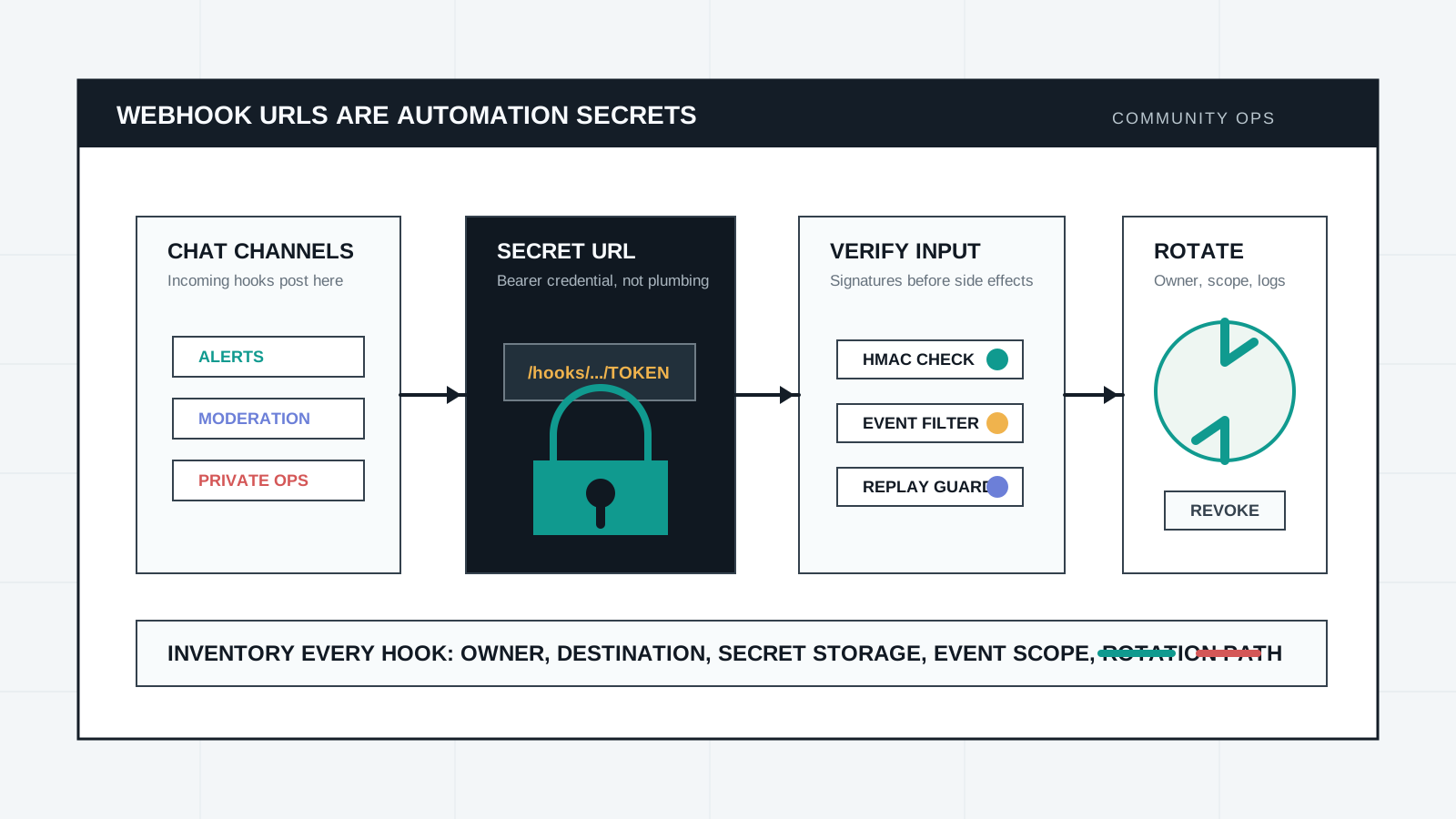
Webhook URLs Are Community Automation Secrets
Slack, Discord, GitHub, and payment webhooks often sit between chat rooms, repositories, bots, and operational systems. Treat each URL and signing secret like a credential with owner, scope, rotation, and logging.
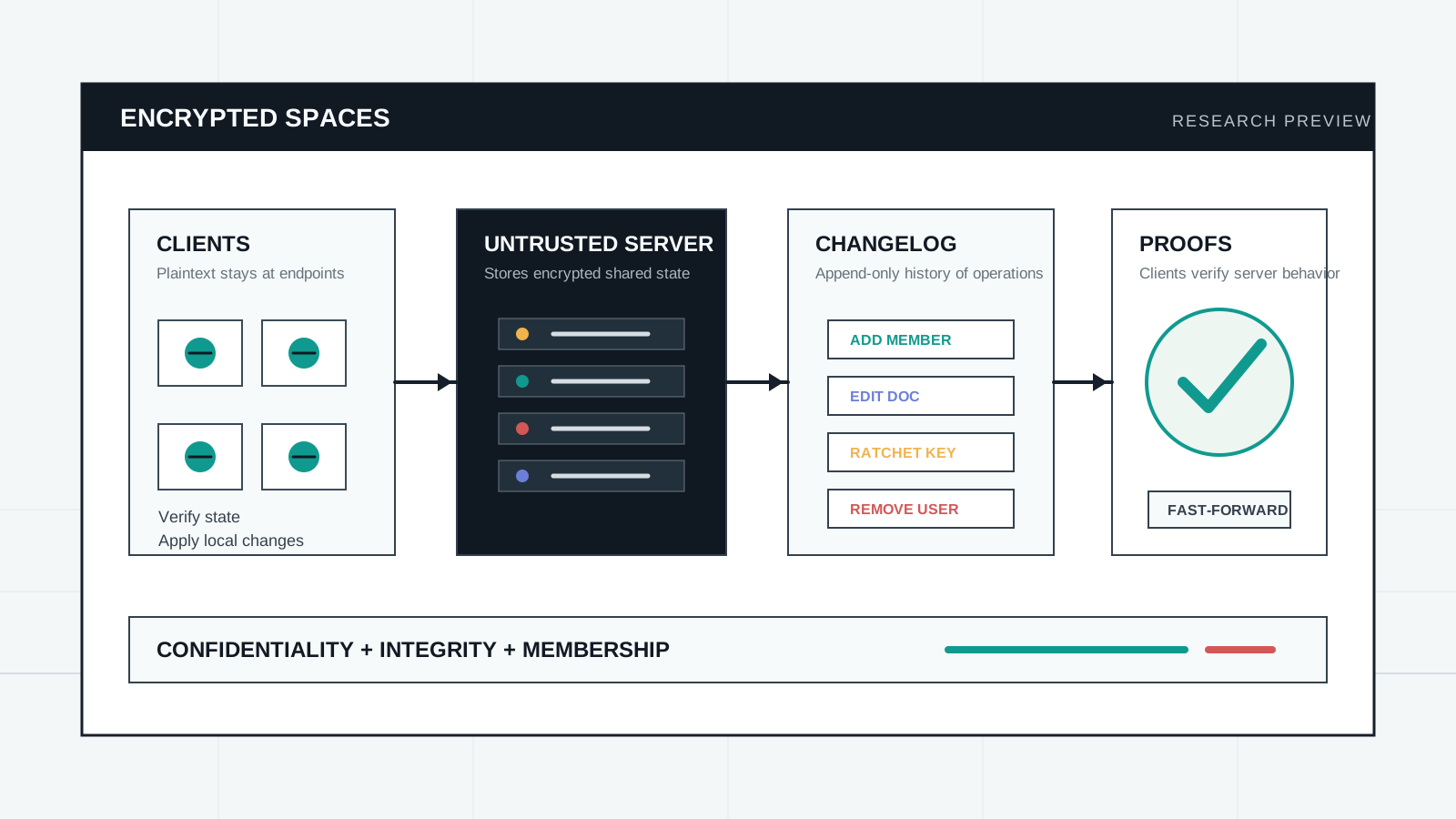
Encrypted Spaces Pushes E2EE Beyond Chat
The June 11 Encrypted Spaces research preview proposes Slack-like collaboration on untrusted servers. The idea is important, but it is still a prototype that needs review before teams treat it as infrastructure.
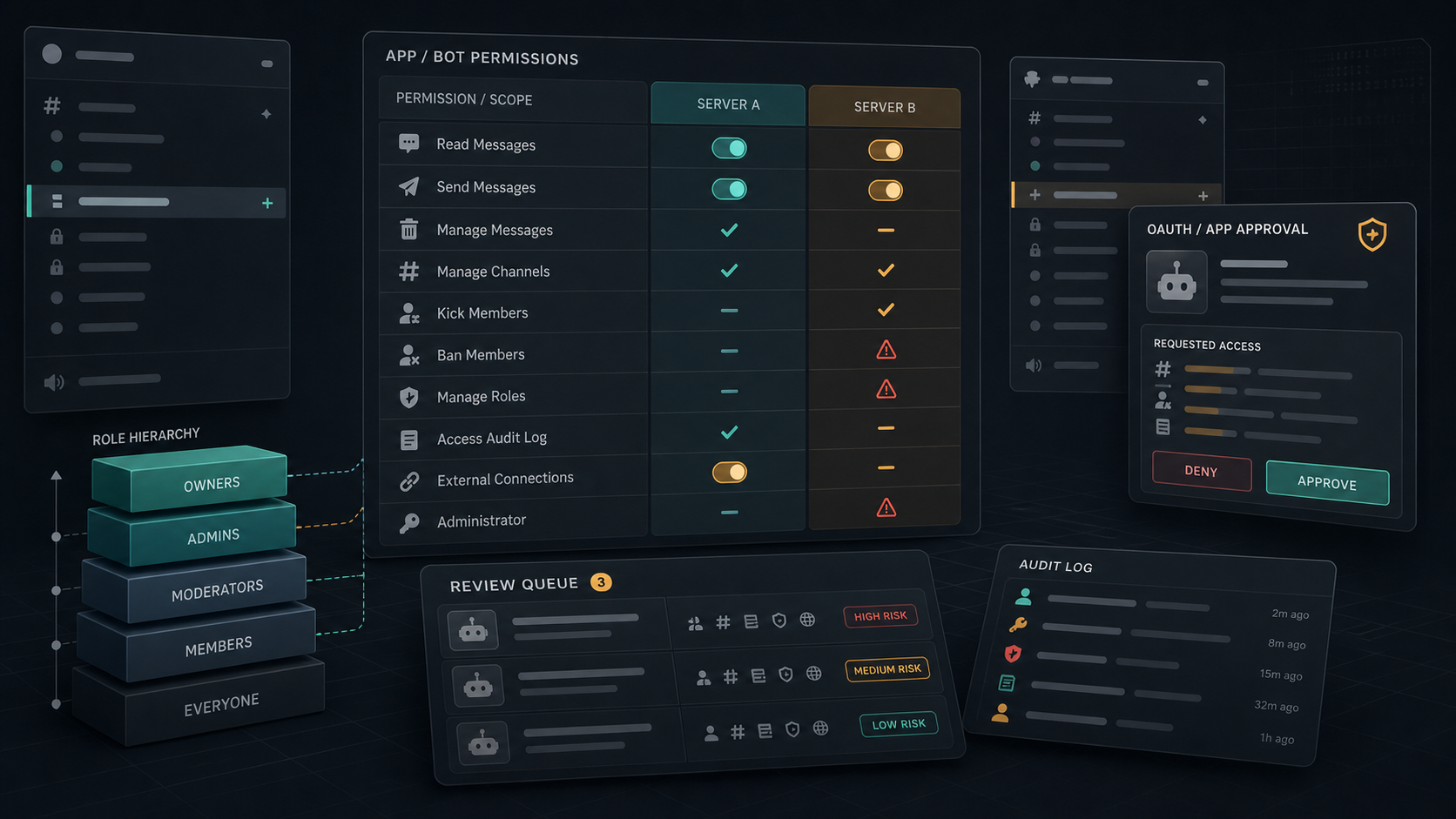
Bot Permissions Are Community Admin Infrastructure
Discord and Slack bots can read channels, post messages, manage roles, and carry long-lived tokens. Treat app approval as privileged infrastructure, not a convenience install prompt.